
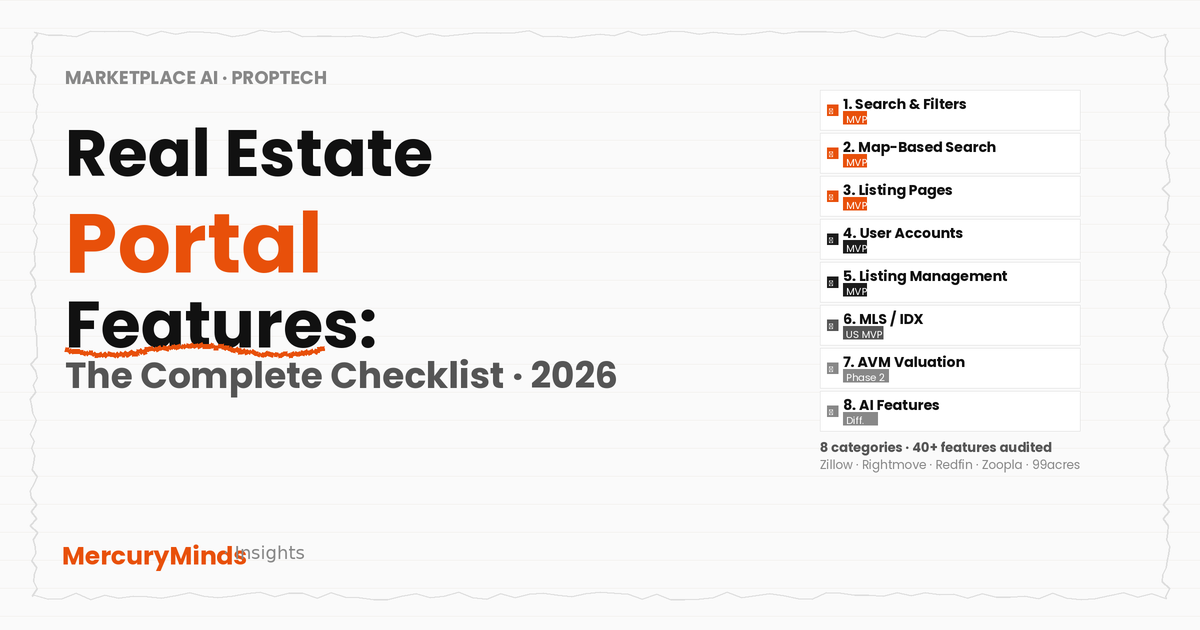
Real Estate Portal Features: The Complete Checklist (2026)
How to use this checklist: This guide is structured for a PropTech founder specifying or auditing a real estate portal — whether you are building from scratch, evaluating white-label solutions, or planning a feature expansion. It covers the complete feature set across eight categories, flags which are MVP-critical versus Phase 2, and audits how five leading global portals implement each category. MLS/IDX integration (for US markets) and AVM integration are covered in dedicated sections because they are the two highest-complexity technical decisions for any portal build.
97% of homebuyers now use the internet during their property search (NAR 2024). The portals that capture that search traffic — Zillow with 235 million monthly unique users, Rightmove as the dominant UK portal, 99acres and Magicbricks in India — are not simply directories of properties. They are data platforms that combine listing inventory, valuation intelligence, neighbourhood context, financial tools, and increasingly AI-powered search and recommendations. A portal that offers listings and a price filter is competing for the same users with a dramatically inferior product.
This checklist defines what the full feature set looks like in 2026, grounded in a feature audit of five leading global portals. It separates MVP-critical features (what you need to launch credibly) from Phase 2 features (what drives engagement and retention over time) from competitive differentiators (what the market leaders do that most competitors do not). The goal is to give a PropTech founder a complete specification baseline, not a list of ideas.
The Feature Checklist: Eight Categories
Each category below is rated by priority tier. MVP features are required at launch for the portal to be credible. Phase 2 features drive retention and monetisation after launch. Differentiator features are competitive edges implemented by the best portals in each market.
Keyword and location search with autocomplete MVP
Address, postcode/zip, city, neighbourhood, or landmark autocomplete backed by a geocoding API (Google Places, Mapbox, or equivalent). Typo tolerance and partial match are expected by 2026 users. Search must resolve to a geographic bounding box for the map view.
Price range filter MVP
Min/max slider or input with currency formatting. For multi-market portals: currency conversion display (not just a single currency). Price filter is the #1 used filter by homebuyers (62% utilisation rate per US consumer survey data).
Bedrooms and bathrooms filter MVP
Integer selector (1, 2, 3, 4, 5+) for bedrooms; 1, 2, 3+ for bathrooms. Half-bath handling for US markets. Studio designation for zero-bedroom rental properties.
Property type filter MVP
House, flat/apartment, condo, townhouse, land, commercial. Market-specific types: for India — independent house, builder floor, villa; for UK — detached, semi-detached, terraced, flat; for US — single-family, multi-family, condo, co-op. Taxonomy must match your target market's conventions exactly — a UK user does not search for "single-family home."
For sale / for rent toggle MVP
Clear buy/rent segmentation at the search level, not buried in filters. Rental sub-filters: furnished/unfurnished, pet-friendly, lease term. Buy sub-filters: new build vs resale, leasehold vs freehold (UK), HOA presence (US).
Floor area / size filter MVP
Square footage (US) or square metres (most other markets). Dual-unit display for portals serving both US and international users. Plot size separate from built-up area for land and large residential.
Amenity and feature filters Phase 2
Parking (garage, off-street), garden/outdoor space, swimming pool, lift/elevator, balcony, pet-friendly, accessibility features. 59% of US homebuyers use specific feature filters (survey data). Keyword search within filters ("near public transport") is a 2026 expectation on mature portals.
Commute time / travel time search Differentiator
Zoopla's Travel Time search lets users find properties within a defined commute time to a work address — by car, public transport, walking, or cycling. Redfin shows commute times to saved addresses on listing pages. This feature consistently drives significant user engagement for commuter-focused buyers and is a meaningful differentiator against portals offering only radius search.
New build filter and developer project pages Phase 2
New build properties require different treatment from resale: project-level pages (not just unit-level), off-plan availability, construction phase status, developer profile pages, and brochure/floor plan downloads. This is a significant revenue stream for portals (developers pay for premium placement) and requires a separate content management workflow from standard listings.
Interactive map with listing pins MVP
Every listing pinned on a map at its geocoded coordinates. Pins display a price marker (not just a dot) — users expect to scan price distribution visually across the map. Cluster markers for areas with high listing density; expand on zoom. The map is the primary browsing interface for the majority of property search users — it is not an optional view mode.
Map/list dual view with synchronisation MVP
Standard split-screen layout (map on one side, listing cards on the other) with hover-to-highlight synchronisation: hovering a listing card highlights the pin on the map, and vice versa. This is the dominant UX pattern from Zillow, Rightmove, and Redfin and is the expected baseline interaction model.
Search-as-you-move-the-map MVP
Results update dynamically as the user pans or zooms the map — not requiring a new search trigger. This is standard on all major portals and directly expected by users. Requires server-side geographic bounding box queries efficient enough to handle pan events without perceptible latency.
Draw-to-search (polygon search) Phase 2
Lets users draw a freehand polygon on the map to define their search area — useful for users with irregular geographic requirements (school catchment area, specific neighbourhood boundary). Zillow and Redfin both implement draw-to-search. It is a meaningful engagement feature for sophisticated buyers who know exactly where they want to live.
Points of interest overlay (schools, transport, amenities) Phase 2
Toggleable overlays showing nearby schools (with ratings where available), public transport stops, supermarkets, parks, and hospitals. Trulia's neighbourhood insights layer is one of the most-cited differentiating features among US portal users. School data is particularly high-value for family buyers — and data sources vary by market (GreatSchools for US; Ofsted for UK; government sources for other markets).
Heatmap overlays (price, crime, schools) Differentiator
Colour-coded area overlays showing price per square metre, relative school quality, or crime index across a city or region. Helps buyers understand relative value and safety across neighbourhoods without requiring local knowledge. Requires third-party data licensing (crime data from official sources; school data from education authorities). High engagement feature but complex data licensing.
High-resolution photo gallery MVP
Full-screen gallery with keyboard navigation, lazy loading for performance, and an image count indicator. Minimum display size: 800×600px. All images must be mobile-optimised with WebP format support. Primary image must be the exterior shot or best room for SEO and social sharing purposes (used as the Open Graph image).
Full property specification table MVP
All core property attributes: price, bedrooms, bathrooms, floor area, plot size, property type, tenure (freehold/leasehold/share of freehold), year built, council tax band (UK) or HOA fees (US), listing ID, and days on market. Missing specifications are a significant source of user frustration and bounce — display the complete field set even when values are "not specified."
Full property description MVP
Agent or owner-written description with expand/collapse for long text. For MLS-sourced listings (US): public remarks field. For direct-submission portals: a rich text editor in the listing management panel. AI-assisted description generation is an emerging feature at the submission layer (2026 differentiator, not MVP).
Floor plan MVP
Floor plan image upload (or interactive floor plan integration for premium listings). A consistently cited missing feature that increases time-on-page and reduces enquiry friction for serious buyers. Rightmove data consistently shows floor plans as one of the top three features buyers want on listings.
Location map on listing page MVP
Embedded map showing the property's location, nearby amenities, and commute context. For privacy reasons, many portals show an approximate pin (100m radius offset) rather than the exact address until enquiry. Decide your policy at build time — exact vs. approximate — and implement consistently.
Enquiry / contact form MVP
Pre-filled with the listing address; fields for name, email, phone, message. GDPR-compliant consent checkbox for EU/UK users. Immediate email notification to the listing agent. On high-traffic portals: phone number display with call tracking. Enquiry conversion is the primary monetisation mechanism for agent-facing portals.
Virtual tour and 3D walkthrough integration Phase 2
Matterport, Zillow 3D Home, or custom 360° tour embed. Video tour support (YouTube/Vimeo embed or direct upload). Listings with virtual tours generate significantly higher engagement — on Rightmove, virtual tours are associated with higher enquiry rates, particularly for buyers relocating from other cities. Required for a premium listing tier.
Price history and listing history Phase 2
Timeline of price changes on the current listing (when did it reduce, by how much?) and listing history (how many times has this property been listed and for how long?). Redfin displays this prominently; Rightmove also shows price history. A consistent signal for serious buyers evaluating negotiation position. Requires historical data storage from day one — cannot be backfilled if not captured at listing creation.
Mortgage calculator on listing page Phase 2
In-line calculator showing estimated monthly payment at the listing price, configurable deposit and interest rate. Trulia integrates mortgage, affordability, and rent-vs-buy calculators directly on listing pages. This is a significant engagement feature — buyers who interact with a mortgage calculator are demonstrably further along the buying journey than those who do not. Integration with mortgage lead generation (a primary portal revenue stream) makes this commercially significant.
EPC / energy rating display Phase 2 · Mandatory EU/UK
Energy Performance Certificate rating display on listing pages. Mandatory for sales and lettings in the UK and EU; increasingly a buyer decision factor (particularly for high energy cost environments). Data source: EPC register APIs (UK: Domestic EPC Register; EU: member state EPC registers).
User registration and authentication MVP
Email/password registration minimum. Social login (Google, Apple) significantly increases registration completion rates and should be included at MVP for consumer portals. Email verification required for GDPR compliance on EU/UK builds. Password reset, 2FA for agent accounts. Store only what is needed — data minimisation is both a GDPR requirement and good practice.
Saved searches with email alerts MVP
The single most important retention and lead generation feature for a real estate portal. Users save a search (location + filters) and receive email alerts when new listings matching their criteria are added. Frequency options: instant (new listing alert), daily digest, weekly digest. This is the mechanism by which portals build habitual usage — users return when they receive a relevant alert, not when they remember to check. Without saved search alerts, most users do not return after their first visit.
Saved / shortlisted listings MVP
Hearting or bookmarking individual listings to a personal shortlist. Shareable shortlist for household decision-making (many portals allow sharing a shortlist link with a partner or family member). Alert when a shortlisted listing has a price change or status update — one of the highest-engagement notification types.
Viewing request scheduler Phase 2
In-portal scheduling of property viewings, integrated with the listing agent's calendar or the agent's own scheduling tool. Reduces enquiry friction for buyers who want to move from interest to viewing without a phone call. Complexity: requires either a native calendar integration or connection to an agent's scheduling tool (Calendly, Google Calendar). High conversion impact for serious buyers.
Market activity alerts Phase 2
Alerts beyond individual listing changes: "3 new listings in [saved area] this week," "average asking prices in [area] have changed by X%," "property you viewed 30 days ago has reduced price." These engagement triggers bring users back to the portal in contextually relevant moments and are a significant driver of re-engagement for cold users.
Property submission form MVP
Multi-step form covering all required property fields. Save-and-continue (listings are not always completed in a single session). Field validation with clear error messaging. Auto-save drafts. For MLS-connected portals (US): MLS data populates automatically from the feed; agents manage listing content through the MLS, not the portal.
Media upload and management MVP
Multi-image upload with drag-to-reorder, auto-compression and WebP conversion, and minimum dimension validation (prevent low-quality uploads that damage portal perception). Video upload or URL embed. Floor plan upload. Virtual tour embed URL field. Storage on a CDN (Cloudflare, AWS CloudFront) is required — serving images from origin for a property portal with hundreds of thousands of listings will fail under load.
Listing status management MVP
Active, Under offer/Under contract, Sold/Let agreed, Withdrawn. Status change must update the public listing immediately (not on next crawl cycle). Listing expiry handling — what happens when a listing expires? Automatic deactivation with renewal prompt? Sold status retention for price history data?
Agent / agency profile pages MVP
Public profile page for each agent and agency showing their active listings, past sales history, contact details, and user reviews (where applicable). Agent profile SEO value is significant — buyers searching for an agent in a specific area should find agent profiles in organic results. Linking listings to agent profiles is the foundational piece of the portal's lead generation value proposition to agents.
Listing performance analytics dashboard Phase 2
Per-listing analytics for agents: views, saves/shortlists, enquiries, click-to-call, days on market, comparable listings performance. This is a core commercial differentiator between portal tiers — premium listings that come with enhanced analytics justify higher subscription fees. The data must be kept up to date and presented clearly enough that an estate agent can understand it without a data analyst.
AI-assisted listing description generation Differentiator
LLM-powered tool that generates a property description draft from structured property attributes (beds, baths, features, location). Agent reviews and edits before publishing. Significantly reduces listing creation time for agents managing large portfolios. IDX Broker introduced this in 2026; Saigon Technology identifies it as a production-ready 2026 feature for custom MLS software builds. Requires quality review workflow to prevent factually inaccurate AI-generated descriptions from going live.
RESO Web API 2.0 data connection US MVP
RETS is retired. All new US real estate portal builds must use the RESO Web API 2.0 standard for MLS data access. Do not build against RETS even if your target MLS still nominally supports it — it will be shut down. The RESO Web API uses OData standards and REST conventions; most MLS boards require a formal application and data licensing agreement before granting API access credentials. Timeline: 4–12 weeks from application to approved credentials for a typical single MLS board.
IDX data display compliance US MVP
Each MLS board has its own IDX display rules governing: required attribution (e.g., "Information provided by [MLS name]"), refresh interval requirements (typically 12–24 hours maximum latency), fields that may and may not be displayed publicly, and co-mingling restrictions. Non-compliance results in IDX access revocation. Implement a compliance monitoring process for each MLS board your portal covers — rules vary across boards and change over time. The August 2024 NAR settlement changed how cooperation and compensation fields are handled in MLS data feeds; any portal built before this date needs a schema review.
Schema normalisation across multiple MLS boards US MVP
There is no single national MLS in the US — there are 500+ separate MLS systems. Each uses slightly different field names, value enumerations, and data structures even within the RESO standard. A portal covering multiple markets must build a normalisation layer that maps each board's schema to a consistent internal data model. Without this, searching across markets produces inconsistent results (bedroom count from one board does not mean the same thing as bedroom count from another). This is the #1 technical underestimation in US real estate portal builds.
IDX vs VOW access decision US MVP
IDX: public-facing, active listings only, no registration required. VOW: registered-user context, includes sold and expired listings, requires formal brokerage participation agreement. For most consumer portals: IDX is sufficient for the public search experience; VOW is worth pursuing if you want to show comparable sold data (which significantly enhances AVM credibility and buyer engagement). VOW requires additional licensing from each MLS board and legal counsel review of the participation agreement.
MLS data vendor vs direct connection decision US MVP
Two paths: vendor-managed IDX (iHomeFinder, IDX Broker, Showcase IDX — $69–$250/month per MLS board; they handle the connection, refresh, and compliance) or direct RESO Web API connection (you build and maintain the integration). For MVP with 1–5 MLS boards: use a vendor. For a national portal covering 50+ boards: a data aggregator (Constellation Data Labs, MLS Grid, Zillow's Data API, or Realtor.com's data partnerships) handles the multi-board complexity more efficiently than building 50+ direct connections.
AVM display on listing pages Phase 2
Estimated current market value displayed alongside asking price (with clear labelling: "Estimated value" not "Valuation"). The Zestimate on Zillow is the most well-known implementation. AVM on listing pages drives enquiry for sellers evaluating whether to sell, and gives buyers context on whether the asking price is above or below estimated market value. Accuracy caveat must be displayed — AVMs are directional, not appraisals.
Home valuation landing page (lead capture) Phase 2
A dedicated "What is my home worth?" page that takes a property address and returns an AVM estimate — gated behind email capture for the detailed report. One of the highest-converting lead generation tools on any real estate portal. Seller leads generated here are among the most commercially valuable for agents (a seller listing is worth significantly more to an agent than a buyer enquiry).
AVM data sourcing decision: build vs buy Technical decision
Building a proprietary AVM requires historical transaction data (typically land registry/public records data), comparable sales data (MLS VOW access for US), property attribute data, and substantial data science investment. Most portals should buy: HouseCanary API, CoreLogic AVM API, ATTOM Data Solutions, or Zillow's Zestimate API (limited availability). Third-party AVM licensing ranges from $0.10–$2.00+ per AVM query depending on volume and provider. Budget this explicitly — AVM queries on a high-traffic portal can generate significant monthly data licensing costs.
Price trend charts by area Phase 2
Charts showing median asking price or sale price trends over 1, 3, and 5 years for a neighbourhood or postcode area. Rightmove's house price index and Zillow's market trends pages implement this. Requires historical transaction or listing data and a charting layer. High engagement for buyers researching market conditions before making an offer.
Semantic / natural language search AI · 2026
"3-bedroom house with a large garden within walking distance of a good primary school in Bristol" — parsed by an NLP model against listing descriptions, attributes, and geo data, returning relevant results without requiring the user to set 12 individual filters. IDX Broker launched natural language search in 2026; Saigon Technology identifies it as a production-ready feature for custom MLS builds. The primary user experience benefit: eliminates the filter-setup friction that causes a significant proportion of users to abandon property search before finding relevant listings.
AI-powered property recommendations AI · 2026
Personalised listing recommendations based on search history, saved properties, and interaction patterns — surfacing listings the user is likely to be interested in before they run a search. Requires a recommendation model trained on user behaviour data; practically, this means building the user behaviour data infrastructure first (tracking which listings users view, how long, whether they save or enquire) and deploying a recommendation layer once data volume is sufficient. Not viable at MVP; plan for it from the data architecture level.
Computer vision photo tagging and quality scoring AI · 2026
AI models that automatically tag listing photos (kitchen, bathroom, bedroom, garden, exterior), flag low-quality images (blurry, dark, or misrepresentative), and identify standout feature images for the primary photo slot. Reduces manual moderation burden at scale and improves the consistency of listing presentation. Practical at any listing volume above a few thousand — the manual alternative is a content moderation team reviewing every uploaded image.
AI chat / property assistant AI · 2026
An LLM-powered chat interface that answers user questions about specific listings ("what is the council tax band for this property?"), the local area ("what are the schools like in this postcode?"), or the buying process ("how does stamp duty work?"). IDX Broker includes a 24/7 AI chatbot; several UK portals are trialling AI property assistants. High engagement potential for users who are uncertain about process steps or local context.
AI virtual room redesign / staging Emerging
IDX Broker launched in 2026 the ability for users to "virtually redesign rooms in a listing" — an AI feature that renders the space with different furniture, flooring, or paint. Primarily a buyer engagement and time-on-site feature rather than a conversion driver in its current form. Emerging rather than established; include in roadmap planning but not as an near-term development priority.
Portal Feature Audit: How the Leaders Do It
The five portals below represent the most trafficked real estate platforms in their respective markets (Similarweb, May 2026). The audit focuses on standout features and notable absences — not a comprehensive feature matrix, but a practitioner's view of what differentiates each portal and what a builder can learn from each one.
Zillow is the benchmark against which all US property portals are measured. Its dominance is built on four structural advantages: the Zestimate AVM (showing estimated value on every property in the US, whether for sale or not — making Zillow useful even when you are not actively buying); the size and freshness of its listing inventory (a combination of MLS feed and direct brokerage syndication); the depth of its financial tools (mortgage calculator, rate comparison, affordability calculator, rent vs. buy comparison); and Zillow Preview, launched in early 2026, which lets agents list properties on Zillow and Trulia before MLS activation.
- Standout: Zestimate on every US property (not just active listings); Zillow Preview pre-market listings; 3D Home tours; draw-to-search; semantic search
- Note for builders: Zillow's data depth (transaction history on non-listed properties) comes from public records data aggregation — a long-term data investment, not a feature you can launch at MVP
- Revenue model: Premier Agent advertising (agents pay to appear alongside listings in their farm area); mortgage origination (Zillow Home Loans)
Rightmove's dominance in the UK is largely structural: it has the most listing inventory (because agents list there for access to the buyer pool, and buyers go there because agents list there — a classic marketplace flywheel). Its feature set is solid but not technically adventurous compared to Zillow; its competitive moat is inventory, not technology. That said, Rightmove's data depth — sold price history going back decades, powered by Land Registry data — is a genuine differentiator for buyers evaluating market conditions.
- Standout: Sold price history (Land Registry integration); property valuation tool; detailed school information; international property search; market trends data
- Note for builders: Rightmove's sold price data comes from HM Land Registry (publicly available in the UK at a postcode level). This is the equivalent of the US's public records data — available for free but requiring significant processing to be useful at scale
- Revenue model: Agent subscription fees (no listing fees per property — agents pay a monthly subscription for inclusion); premium listing upgrades
Redfin's differentiation is in data freshness and agent integration. Its direct MLS connection delivers faster listing updates than Zillow's syndication model — important in fast-moving markets where a property can go under offer within hours of listing. Its "Hot Homes" algorithm flags properties likely to receive offers quickly, giving active buyers a useful prioritisation signal. Redfin also integrates its own agent services directly into the portal — a different business model from portals that are pure lead generators for independent agents.
- Standout: Fastest MLS data (direct connection); Hot Homes algorithm; price drop alerts; Walk Score, Transit Score, and Bike Score on every listing; detailed days-on-market history
- Note for builders: Redfin's Hot Homes algorithm requires historical data to train on — it identifies properties likely to go quickly by comparing current listing characteristics against historical comparables. Not buildable at MVP; plan for it once you have 12+ months of transaction data
- Revenue model: Redfin's own agents (seller and buyer representation); partner agent referral fees; mortgage services
Zoopla is Rightmove's primary UK competitor and differentiates through data richness and search innovation. Its Travel Time search — finding properties within a defined commute time to a given address, by multiple transport modes — is one of the most user-appreciated features on any property portal and a significant driver of time-on-site for commuter-focused buyers. Zoopla also produces the Zed-Index (a market-wide AVM) and has more aggressive data visualisation than Rightmove, including neighbourhood comparison charts.
- Standout: Travel Time search (genuinely differentiated); Zed-Index AVM; area comparison tool; demand/supply indicators for areas; sold prices integrated with active listings
- Note for builders: Travel Time search requires integration with a routing API (Google Maps Routes API, TomTom, or HERE) with isochrone queries — computationally more expensive than standard radius search but very achievable with the right API integration
99acres operates in a structurally different environment from US or UK portals: India has no MLS infrastructure. All listings are directly submitted by agents, builders, and individual sellers. This means the listing data quality challenge is fundamentally different — rather than normalising data from a structured MLS feed, 99acres must manage data quality across millions of human-submitted listing records with high levels of duplication, inaccuracy, and incomplete data. Its verified listing badge, which flags listings that have been physically verified by a 99acres representative, is a direct response to this trust problem.
- Standout: Verified listing badge (physical verification); builder project pages (prominent — new residential development is a larger share of the Indian market); locality rankings (neighbourhood comparisons by price, connectivity, amenities)
- Note for builders: For portals in markets without MLS (India, Middle East, Southeast Asia, most of Europe), the primary data quality challenge is managing human-submitted listings — de-duplication, image moderation, price validation, and verified status become the operational core of the product
MLS/IDX and International Data Equivalents: Decision Guide
The MLS/IDX infrastructure described in Category 6 is specific to the US and Canada (where the equivalent is Canada's DDF — Data Distribution Facility, operated by CREA). For PropTech founders building for other markets, the data access model is fundamentally different.
| Market | Data infrastructure | Listing source | Sold data | Key considerations |
|---|---|---|---|---|
| US | MLS / IDX via RESO Web API 2.0 | Automated MLS feed | MLS VOW or public records | 500+ separate MLS boards; no single national feed; RETS retired |
| Canada | CREA DDF | CREA DDF feed | Board-specific | CREA DDF provides national coverage; province-specific rules apply |
| UK | Portal aggregation (no MLS) | Direct from agents/portals | HM Land Registry (free public API) | No MLS; listings submitted directly; Land Registry sold prices are public |
| India | Portal aggregation (no MLS) | Direct from agents/builders | Registration dept. records (patchy) | Data quality is the primary challenge; verification programmes are key |
| EU (Spain, France, Germany) | Fragmented; portal-led distribution | Direct from agents/portals | Notary records (limited API access) | Idealista, SeLoger, ImmoScout24 dominate; no pan-European MLS |
| Middle East (UAE, KSA) | Portal aggregation (no MLS) | Direct from brokerages | DLD (Dubai) partial open data | Bayut, Property Finder, Dubizzle dominate UAE; quality varies significantly |
MVP vs Full Vision: The Build Sequence That Works
The most expensive real estate portals are those that tried to launch with Zillow's full feature set. The most successful portals launched with a clearly scoped MVP, captured early user behaviour data, and used that data to prioritise the Phase 2 roadmap. The MVP must be credible — users will leave a portal with no AVM, no map search, or no saved searches because the alternatives have these features. But the MVP does not need travel time search, AI recommendations, or computer vision photo tagging to be useful.
A credible MVP launch sequence for a regional consumer real estate portal:
- Core search + map + listing pages — Categories 1, 2, and 3 (MVP items only). No AVM, no commute search, no AI. Just great property search and complete listing pages.
- User accounts + saved search alerts — Category 4 MVP items. This is the retention mechanism without which most users do not return after their first visit.
- Listing management + agent profiles — Category 5 MVP items. This is the supply side — without agents able to manage their listings, you do not have inventory.
- MLS/IDX integration or direct submission — Category 6 for US; direct submission system for international. This is the data source; without it, you have nothing to search.
- AVM + mortgage calculator — Category 7. These are the engagement features that move a portal from "listing directory" to "property intelligence platform." They can follow launch but should be on the roadmap from week one.
Build cost guidance: an MVP covering the first four steps above costs $50,000–$120,000 for a single-market regional portal without MLS complexity. Adding MLS integration (US) or a data normalisation layer for direct submissions adds $30,000–$80,000. AVM integration adds $15,000–$40,000 for setup plus ongoing data licensing. Full build including mobile apps, AI features, and multi-market MLS: $250,000–$450,000+.
MercuryMinds builds real estate portals for PropTech founders across the full stack — from architecture through launch. Our real estate portal practice covers MLS integration, AVM, map search, and the data infrastructure that makes the portal competitive over time.
Limitations of This Checklist
- Portal features and competitive positioning change rapidly. The Zillow Preview feature (April 2026), IDX Broker AI features (2026), and Zoopla's product set all reflect mid-2026 information. Verify current features at each portal's own product pages before using this audit in a competitive analysis.
- IDX vendor pricing ($69–$250/month) and MLS board rules are sourced from Listing Beam (June 2026) and Luxury Presence (April 2026). Verify current pricing at each vendor directly — SaaS pricing changes frequently and MLS board rules are board-specific.
- The build cost range ($50K–$450K) is from biz4group (May 2026). Actual costs depend on team rates, market, complexity, and existing infrastructure. Build your own cost model from agency quotes before committing to any budget figure.
- MLS/IDX compliance rules are board-specific and change over time. The NAR August 2024 settlement impact on compensation fields is documented; further rule changes may have occurred between publication and your build. Engage legal counsel with real estate technology experience for compliance review.
- GDPR and data protection requirements for user account data, enquiry data, and tracking data are not fully covered in this checklist — they require a separate legal and technical review for any portal targeting EU or UK users.
Building a real estate portal and need an experienced development and data partner?
MercuryMinds has built marketplace and portal platforms across real estate, ecommerce, and B2B verticals for 17+ years. We cover architecture, MLS/IDX integration, AVM integration, map search, and the data infrastructure that separates a lasting portal from a listing directory.
Talk to the TeamFrequently Asked Questions
What features does a real estate portal need?
A real estate portal needs features across eight categories: core search with advanced filters and map-based search; listing detail pages with photo galleries, floor plans, specifications, and financial tools; listing management tools for agents; user accounts with saved searches and email alerts; MLS/IDX integration for US markets or a direct listing submission system for others; an automated valuation model for property value estimates; agent and agency profile pages; and AI-powered features including semantic search, recommendations, and AI-assisted listing tools. The MVP requires the first four categories to be credible at launch; the remaining categories drive engagement and commercial value over time.
What is MLS/IDX integration for a real estate portal?
MLS stands for Multiple Listing Service — the cooperative databases used by real estate agents in the US and Canada to share listing data. IDX (Internet Data Exchange) is the policy framework and technology that allows portals to display that MLS data on their platforms, updating automatically as properties are listed, sold, or withdrawn. In 2026, the technical standard for MLS data access is the RESO Web API 2.0, which has replaced the older RETS protocol now retired by most MLS boards. There are approximately 500 separate MLS systems in the US, so national coverage requires either many individual integrations or a data aggregator. For international portals outside the US and Canada, MLS/IDX infrastructure does not exist, and portals use direct listing submission from agents and developers instead.
What is an AVM in real estate?
An Automated Valuation Model (AVM) is a computer-generated estimate of a property's current market value, calculated using comparable sales data, property characteristics, location factors, and market trend data. The best-known AVM is Zillow's Zestimate, which appears on every listing on Zillow's platform. For a real estate portal, integrating a third-party AVM provider — HouseCanary, CoreLogic, ATTOM Data, or similar — is faster and more reliable than building a proprietary model from scratch, as the data infrastructure required to train and maintain an accurate AVM is substantial. AVMs are most accurate in high-turnover markets with plentiful comparable sales data, and least accurate for unusual or rural properties with limited comparables.
How much does it cost to build a real estate portal?
Building a real estate portal costs between $50,000 and $450,000 or more depending on scope and features. A minimum viable portal with core search, listing management, map integration, and user accounts: $50,000 to $120,000. Adding MLS/IDX integration, AVM, advanced filters, and agent profile tools: $120,000 to $250,000. A full-featured platform with AI search, 3D tours, mobile apps, multi-MLS aggregation, and agent CRM: $250,000 to $450,000 or more. Ongoing costs include IDX vendor fees ($69 to $250 per month per MLS board), map API costs, AVM data licensing, and server infrastructure.
What is the difference between an IDX website and a VOW in real estate?
IDX (Internet Data Exchange) allows real estate portals to display active listing data publicly, without user registration required. A VOW (Virtual Office Website) provides registered users with access to a broader dataset including sold listings, withdrawn listings, and more detailed property history that IDX rules do not permit to be shown publicly. VOW requires formal brokerage participation agreements with each MLS board. For portal builders: IDX is the standard for public consumer search; VOW is worth pursuing when you want to show comparable sold data to registered users, which significantly enhances AVM credibility and supports serious buyers evaluating negotiating position.