
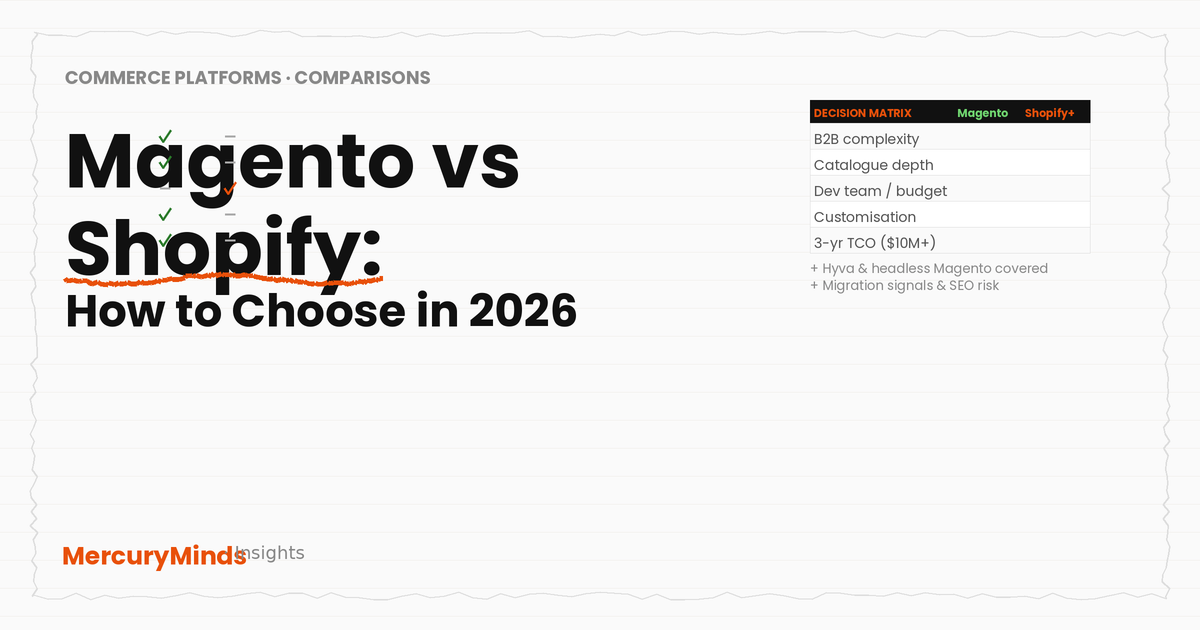
Magento vs Shopify: How to Choose in 2026
The short answer: Shopify Plus wins for DTC brands, multi-channel sellers, and organisations where speed-to-market and operational simplicity matter more than deep PHP customisation. Magento (Adobe Commerce) wins for complex B2B operations, multi-storefront architectures, deep ERP integration requirements, and businesses that need code-level control that Shopify's API model cannot provide. The 2026 context has shifted: Magento developer talent has become genuinely scarce and expensive; Shopify Plus has added significant B2B capability; and Adobe's push toward ACCS has made Magento's long-term product direction a legitimate strategic risk factor. Neither platform is obviously right — the decision requires scoring your specific situation, not accepting a category recommendation.
This guide is written for mid-market founders and CTOs who are either evaluating these platforms for a new build, considering migrating an existing Magento store to Shopify Plus, or trying to quantify the real cost difference for a board-level conversation. We work with both platforms. The decision framework at the centre of this article is designed to give you a structured answer — not a marketing position.
We will work through the key decision dimensions, build a scored matrix, examine real TCO at mid-market scale, and cover the migration signals that suggest it is time to move — or to stay put and optimise.
Market Context: Where These Platforms Stand in 2026
The numbers tell a directional story worth understanding before diving into features. According to BuiltWith data cited by Charle (June 2026), approximately 126,000 live stores ran on Magento in mid-2025 — down around 11% year-on-year. Shopify crossed 2.66 million live stores in the same window, up roughly 9%. Around 520 stores migrate from Magento to Shopify in any given 90-day period. This is not a reason to abandon Magento — large, complex stores have excellent reasons to stay — but it is the context for the talent and ecosystem trends discussed below.
Magento 2.4.9 reached general availability on May 12, 2026, adding PHP 8.5 support and native PHP MVC. The platform is actively maintained. Adobe Commerce as a Cloud Service (ACCS) — Adobe's new SaaS model — launched in 2025 and represents Adobe's primary strategic investment direction, which creates a question mark about Adobe's long-term investment in the traditional on-premise and PaaS Adobe Commerce tiers. We cover this below.
Platform Fundamentals: What You Are Actually Choosing
The architectural difference between these platforms drives every other comparison. Shopify is a hosted, multi-tenant SaaS platform — you subscribe, Shopify manages the infrastructure. Magento (in its Open Source and Adobe Commerce editions) is an open-source PHP application you self-host, or that Adobe hosts for you on a dedicated PaaS environment (Adobe Commerce Cloud) or, newly, in a SaaS model (ACCS). The implications:
- On Shopify Plus, your team builds commerce capabilities using Shopify's Liquid theme system, its app ecosystem (12,000–18,000+ apps), and Shopify's APIs. Checkout customisation uses Shopify Functions and Checkout UI Extensions. You cannot modify Shopify's PHP core because there is no PHP core to modify.
- On Magento, your team has full access to a PHP codebase that can be modified at any layer. Custom modules, custom checkout flows, custom pricing engines, custom admin interfaces — anything is technically possible. The trade-off is that every customisation must be maintained across Magento's upgrade cycle, and the complexity compounds over time.
For most mid-market DTC brands, Shopify's constraint is not a real constraint — the app ecosystem covers the vast majority of commerce requirements, and Shopify Functions covers most custom checkout logic. For complex B2B manufacturers, distributors, and multi-brand enterprises, the constraint becomes real, and Magento's flexibility is genuinely valuable.
The Scored Decision Matrix
This is the centrepiece of the comparison. Score each dimension based on your specific situation, using the criteria below. At the end, the platform with the higher total score is likely the better fit — but treat this as a structured input to the decision, not a mechanical output.
How to use this matrix: For each dimension, the criteria describe situations where each platform has a meaningful advantage. Score 1 for the platform that fits your situation, 0 for the other, or 0.5 for each if genuinely neutral. Your total across five dimensions gives a directional recommendation. Then read the explanatory text for each dimension below.
A score of 3–5 on either side is a strong indication. A score of 2–3 means the decision is genuinely close and you should run detailed TCO maths for your specific situation before committing. The sections below give the evidence behind each dimension.
Dimension 1: Business Model — B2B vs DTC vs Hybrid
B2B is still the clearest differentiator between the two platforms, though the gap has narrowed in 2025–2026.
Adobe Commerce's B2B suite
Adobe Commerce includes a comprehensive, native B2B module covering company accounts with role-based permissions, shared catalogues (different products and prices for different company accounts), negotiable quotes with multi-round negotiation, purchase order approval workflows, requisition lists, and credit limits with payment-on-account. This is not a bolt-on — it is built into the core data model. For a wholesale distributor or manufacturer where these workflows define how customers buy, the native B2B suite is a genuine operational advantage. Replicating it on Magento Open Source or Shopify Plus requires significant extension assembly or custom development that often costs more than the Adobe Commerce licence itself.
Shopify Plus B2B in 2026
Shopify's native B2B functionality (available on Plus) has expanded significantly since its 2022 launch. In 2026, Shopify B2B supports company accounts with multiple buyers, customer-specific pricing and catalogues, draft orders, payment terms, and purchase order workflows. IWD Agency's May 2026 analysis characterises Shopify Plus as a "unified B2B + DTC" platform — the same store can serve both audiences with different experiences. For most SMB B2B operations and for DTC brands with a B2B wholesale channel alongside their retail business, Shopify Plus B2B is sufficient. The gap remains at the upper end: multi-tier purchase approval workflows, complex negotiated quote flows across enterprise buying organisations, and integration with legacy B2B procurement systems are still stronger on Adobe Commerce.
Dimension 2: Catalogue Size and Complexity
Both platforms handle large catalogues, but the operational requirements differ. Shopify scales catalogue size automatically — unlimited products, managed infrastructure, no SKU limits at any tier. Shopify's constraint is on the product data model: 2,048 variants per product, three option types per product (colour, size, material). For most retail catalogues this is sufficient. For industrial parts catalogues, highly configurable products, or complex product configurators, the Shopify model can require restructuring how products are represented.
Magento's configurable product types, custom option sets, and fully extensible attribute architecture handle complex product data models more naturally. A manufacturer selling components with 15 configurable dimensions is better served by Magento's EAV data model than by Shopify's fixed product schema — though both platforms can handle the use case with the right approach.
One nuance: large catalogue performance on Magento requires the optimisation stack described in our WooCommerce vs Shopify guide (Elasticsearch/OpenSearch for search, Redis for caching, managed cloud hosting, Hyvä frontend). The ceiling once optimised is very high — 100,000+ SKUs with sub-second search. Shopify achieves comparable search performance through apps (Boost Commerce, Searchanise) but at lower operational overhead.
Dimension 3: Developer Talent and Real Maintenance Cost
This is the dimension most TCO comparisons underweight, and it is increasingly decisive in 2026.
The Magento talent reality
The Magento developer pool has been contracting as the platform has ceded market share. ECommerce Partners (March 2026) notes that experienced Magento 2 developers command $150–$250/hour for US agency work, and senior hiring timelines stretch 60–120 days for in-house roles. This is not universal — Eastern European talent markets remain competitive ($40–$110/hour per abbacustechnologies.com, 2026), and offshore hybrid teams are the standard approach for most mid-market brands. But the US-based skill shortage is real: the Magento talent pool is a subset of a subset (PHP developers with Magento certification, understanding of EAV architecture, and deployment pipeline expertise). Finding someone who also understands Hyvä, Adobe Commerce's B2B module, and ACCS architecture narrows the pool further.
Monthly agency retainers for Adobe Commerce maintenance run $12,000–$40,000 based on IWD Agency's 2026 data. A complex Adobe Commerce environment — multi-storefront, heavy customisations, ERP integration — sits toward the upper end of that range. Compare this to Shopify Plus retainers at $8,000–$30,000/month for equivalent complexity, and Shopify's lower ongoing maintenance burden because the platform handles infrastructure, security, and updates.
The Shopify talent advantage
Shopify development uses a more accessible stack — Liquid templating, JavaScript, and Shopify's documented APIs. Competent Shopify developers are available at $80–$150/hour in the US. The talent pool continues to grow with the platform's market share. For a mid-market brand that needs to hire developers, the shorter pipeline and lower base rate are operational advantages that compound over a multi-year relationship.
Dimension 4: Customisation Depth
Shopify's customisation model has expanded substantially with Shopify Functions (custom checkout logic, custom discounting, custom delivery methods, custom payment methods — all without App Bridge overhead) and Shopify Markets (localised storefronts across 50 markets from a single admin). For most mid-market use cases, these tools cover the requirements. The specific gap remaining in 2026:
- Deeply integrated ERP pricing engines — where product pricing is calculated in real time from an ERP based on customer tier, contract terms, and inventory position. Shopify's price list system covers most cases; complex real-time ERP price calculation at the line-item level requires more work.
- Multi-storefront with shared inventory on a single database — Shopify Markets handles localisation well, but running genuinely independent storefronts (separate brands, separate catalogues, shared inventory) on a single Shopify account has limitations. Adobe Commerce handles this natively with its multi-site architecture.
- Complex procurement integration — punchout catalogues, EDI 850/855/856/810, government procurement portals. Adobe Commerce's PHP flexibility handles these integration patterns more naturally.
- Custom admin workflows — internal tools built into the admin (custom fulfilment screens, custom reporting interfaces, operations tools) are straightforward PHP modules on Magento. On Shopify, custom admin interfaces require building Shopify Apps, which adds overhead.
Dimension 5: Total Cost of Ownership at Mid-Market Scale
The numbers below are compiled from 2026 agency analyses. All ranges are estimates — run your own model with your specific inputs.
| Cost component | Adobe Commerce (on-premise) | Adobe Commerce Cloud (PaaS) | Shopify Plus |
|---|---|---|---|
| Platform licence / subscription | ~$22K–$125K+/year (GMV-tiered, negotiated) | ~$40K–$190K+/year (licence + hosting) | From $27,600/year ($2,300/mo); +0.25% GMV above ~$10M/year |
| Hosting / infrastructure | $5K–$15K/month (production-grade dedicated) | Included in Cloud pricing | Included in subscription |
| Initial build cost | $80K–$400K+ (new build) | $80K–$400K+ (new build) | $50K–$250K (new build) |
| Annual developer retainer | $144K–$480K/year (agency) or equivalent in-house salary | Same as on-premise (app-level development) | $96K–$360K/year (agency); lower complexity |
| App / extension stack | $10K–$30K/year (commercial extensions) | $10K–$30K/year | $15K–$50K/year (apps, typically more) |
| Security / patching overhead | High — quarterly Patch Tuesday cadence, upgrade cycles $50K–$200K each | Lower — Adobe manages infrastructure patching | None — managed by Shopify |
| 3-year mid-market TCO estimate | $500K–$1.5M (Charle, June 2026) | $600K–$2M (higher hosting cost) | $200K–$600K (ECOSIRE, March 2026) |
TCO sourcing note: All ranges are from agency analyses (Charle June 2026, ECOSIRE March 2026, ECommerce Partners March 2026, IWD Agency May 2026). Adobe Commerce pricing is not publicly disclosed — all contract figures are negotiated. The Shopify Plus GMV fee structure (0.25% above ~$800K/month) is confirmed from Charle (June 2026) and Craftshift (May 2026). Run a formal quote process with both Adobe and Shopify before using these figures for budget decisions.
Magento's Strategic Trajectory: The ACCS Question
One factor that did not appear in Magento vs Shopify comparisons three years ago but now deserves explicit attention: Adobe's strategic direction.
Adobe Commerce as a Cloud Service (ACCS) — a true SaaS model launched in 2025 — represents Adobe's primary platform investment vector. ACCS is multi-tenant (your store shares infrastructure with other stores), versionless (updates ship automatically), and built around Edge Delivery Services for the frontend and App Builder for customisation. It is a meaningfully different architecture from the traditional on-premise and PaaS Adobe Commerce models.
What this means for merchants on traditional Adobe Commerce: Adobe has confirmed that on-premise and Cloud (PaaS) tiers remain fully supported with no forced migration. But the pattern of where Adobe's product team is investing its roadmap effort — feature development, AI capabilities, performance improvements — increasingly centres on ACCS and the Experience Cloud integration layer. Multiple industry analysts characterise traditional Adobe Commerce as "in maintenance mode" relative to ACCS investment, though Adobe has not made this characterisation officially.
For a mid-market brand building on Adobe Commerce today with a 5-year horizon, this is a real strategic question: are you building on a platform that Adobe is actively developing toward your use case, or on a platform whose primary long-term form is moving toward a SaaS model your customisation requirements may not fit? There is no definitive answer, but the question belongs in any serious platform evaluation conversation.
When to Migrate from Magento to Shopify Plus
The decision to migrate should be driven by a quantified comparison, not by platform marketing. The signals that indicate migration is worth modelling seriously:
Retainer cost has become the dominant platform cost
If your development agency or in-house team is spending the majority of its time maintaining Magento's infrastructure, applying patches, and managing upgrade cycles — rather than shipping commerce capabilities — your developer budget is generating infrastructure value rather than business value. This is the most common migration trigger in 2026.
You are behind on security patches
An unpatched Magento store is a security liability. If your store is running on a version that has reached end-of-support, or is more than two minor versions behind on security patches, the upgrade cost may approach or exceed migration cost — and you are exposed in the interim. This is the inflection point where a migration TCO model typically favours Shopify Plus.
You are a DTC brand with no genuine B2B requirements
Many brands built on Magento 5–8 years ago have grown into DTC and omni-channel operations that do not need Adobe Commerce's B2B suite. If your B2B requirements are basic (wholesale price lists, draft orders), Shopify Plus B2B handles them. Staying on Magento to maintain B2B features you barely use while paying Magento's maintenance overhead is poor allocation of development budget.
Multi-channel selling is a primary growth motion
Shopify's native integrations with Amazon, TikTok Shop, Instagram Shopping, and 15+ other channels with synced inventory are a genuine operational advantage for brands where marketplace and social commerce drive growth. Magento can replicate this via extensions, but the configuration and maintenance overhead is materially higher.
The migration itself
A Magento to Shopify Plus migration for a mid-market store takes 10–16 weeks (IWD Agency, May 2026). The primary work components: data migration (products, customers, orders), custom feature replication in Shopify, URL redirect mapping for SEO, theme/design rebuild, and integration reconnection (ERP, PIM, 3PL). The SEO risk is real — Shopify's fixed /products/ URL structure differs from Magento's configurable URL patterns, requiring a comprehensive redirect map before go-live. Well-executed migrations with complete redirects see temporary ranking dips of 5–10% in weeks 2–4, recovering to baseline by week 8 and improving beyond baseline on lower-competition keywords by week 12, per IWD Agency's migration data.
If you are considering this migration, our Magento to Shopify migration process covers the technical migration, redirect strategy, and post-launch monitoring in a structured engagement.
When to Stay on Magento (or Move to Adobe Commerce)
The migration narrative dominates industry content. The case for staying on — or moving to — Magento deserves equal airtime.
- You are a complex B2B operation and need native company accounts, shared catalogues, negotiated quotes, and purchase approval workflows. Building this on Shopify Plus costs more than Adobe Commerce's licence and delivers less depth.
- You have established in-house Magento expertise and a development team that genuinely understands the platform. The "expensive Magento maintenance" problem is largely an agency-dependency problem — stores with strong in-house capability run Magento efficiently at lower cost.
- You are in a regulated industry requiring on-premise hosting for data residency, security audit, or sector-specific compliance reasons. Shopify's cloud-only model cannot accommodate certain government, healthcare, or defence sector requirements.
- Your ERP is tightly integrated with Magento and the integration covers complex pricing, inventory, and order management logic. Rebuilding that integration on Shopify's API model is a substantial project with risk — the cost of the migration may exceed the benefit.
- You run multiple brands on a single backend and need genuinely independent storefronts sharing a unified data layer. Adobe Commerce's multi-site architecture is native here; Shopify's equivalent requires Shopify Markets or multiple stores with synchronisation middleware.
Feature Comparison: 2026
| Feature | Adobe Commerce (Magento) | Shopify Plus | Winner |
|---|---|---|---|
| Platform type | Open-source PHP (self-hosted or PaaS/SaaS) | Hosted SaaS, multi-tenant | Depends on preference |
| B2B native suite | Comprehensive (company accounts, shared catalogues, negotiable quotes, PO workflows) | Solid for SMB B2B; gaps at complex enterprise B2B | Adobe Commerce |
| Catalogue flexibility | Full EAV architecture; configurable, bundle, grouped products; unlimited attributes | 2,048 variants/product; 3 options; unlimited products | Adobe Commerce (complex catalogues) |
| Checkout customisation | Full PHP access; any flow possible | Shopify Functions + Checkout UI Extensions on Plus | Tie for most cases; AC wins at extremes |
| Multi-storefront | Native multi-site architecture on one database | Shopify Markets (up to 50); multiple stores need middleware | Adobe Commerce |
| Multi-channel selling | Via extensions; more configuration required | 20+ native channels (Amazon, eBay, TikTok, Instagram) | Shopify Plus |
| SEO control | Full URL control; configurable structure; deep schema control | Fixed /products/ URL; strong native JSON-LD; improving | Adobe Commerce |
| Time to launch (new build) | 14–22 weeks (B2B); 10–16 weeks (standard) | 8–14 weeks (B2B); 6–10 weeks (standard) | Shopify Plus |
| Developer cost | $150–$250/hr US agency; $40–$110/hr Eastern Europe | $80–$150/hr US agency; lower overall | Shopify Plus |
| Developer availability | Scarce; 60–120 day hire timelines for senior US roles | Growing pool; faster hiring | Shopify Plus |
| Infrastructure management | Your responsibility (on-premise) or Adobe's (Cloud/ACCS) | Fully managed by Shopify | Shopify Plus |
| AI / personalisation | Adobe Sensei (additional paid services); can integrate any AI layer | Shopify Magic + Sidekick built-in; AI apps in ecosystem | Tie (different tools, comparable capability) |
| Long-term strategic trajectory | On-premise/PaaS investment question; ACCS is Adobe's SaaS direction | Clear roadmap on single SaaS platform; consistent investment | Shopify Plus |
Hyvä, Headless, and the Modern Magento Architecture
Any 2026 Magento vs Shopify comparison that does not mention Hyvä is working from outdated assumptions. Hyvä Themes has become the dominant modern frontend for Magento stores, replacing the legacy Luma theme stack that made Magento stores notoriously slow. Understanding what this means for the comparison is important.
What Hyvä changes for Magento
Hyvä replaces Magento's Luma frontend — built on KnockoutJS and RequireJS, technologies that are now genuinely old — with a dramatically simpler Alpine.js and Tailwind CSS stack. The result is significantly better Core Web Vitals scores: Hyvä-themed Magento stores routinely achieve 85–95 Lighthouse scores on mobile, competitive with well-optimised Shopify storefronts. A Magento store on Luma with a heavy plugin stack can score 20–40; the same store rebuilt on Hyvä typically reaches 80–90. Hyvä is commercially licensed (~€1,000/year) and has wide compatibility with the extension ecosystem, though some extensions require Hyvä-specific compatibility modules.
In 2026, Hyvä expertise is effectively a job requirement for Magento frontend developers, as Qualimero and Charle both note in their 2026 platform analyses. When evaluating Magento agency or developer capacity, Hyvä experience should be on your shortlist alongside core PHP and module development capability.
Headless Magento as an alternative
A growing segment of mid-market and enterprise Magento stores runs a decoupled architecture: Magento (or Adobe Commerce) as the backend API, with a React or Next.js frontend via PWA Studio, Vue Storefront, or Hydrogen-style custom builds. This architecture achieves the fastest possible frontend performance and maximum design freedom, at the cost of the highest development complexity and cost. It is well-suited to brands where conversion rate improvements from frontend speed directly justify the engineering investment — typically stores with significant monthly revenue where a 1% conversion improvement is worth $50,000+/year. For most mid-market brands, Hyvä delivers 90% of the performance benefit at a fraction of the cost.
The parallel on the Shopify side is Shopify's Hydrogen framework — a React-based headless storefront toolkit that Shopify officially supports and builds around. Hydrogen stores, deployed on Oxygen (Shopify's edge hosting), achieve similarly fast performance to headless Magento, with the advantage of staying within Shopify's managed infrastructure. For a brand evaluating headless commerce and deciding between platforms, the Hydrogen + Oxygen combination is meaningfully simpler to operate than a self-hosted headless Magento stack — at the cost of Shopify's API constraints on the backend.
Quick-Reference Summary
| Situation | Recommended | Primary reason |
|---|---|---|
| Complex B2B: company accounts, negotiated quotes, PO approvals | Adobe Commerce | Native B2B suite; no equivalent extension assembly cost |
| DTC brand, multi-channel, lean technical team | Shopify Plus | Managed infra, 20+ native channels, lower developer cost |
| Catalogue 50K+ SKUs with complex attribute logic | Adobe Commerce | EAV data model; unlimited attribute flexibility |
| Multi-brand, multi-storefront, single data layer | Adobe Commerce | Native multi-site architecture on one database |
| Behind on Magento patches, high retainer cost | Migrate to Shopify Plus | Upgrade cost often exceeds migration cost at this point |
| In-house Magento team, revenue $10M+, B2B primary | Stay on Adobe Commerce | Internal team reduces retainer cost; GMV fee vs licence maths may favour AC |
| Regulated industry requiring on-premise hosting | Adobe Commerce (on-premise) | Shopify cloud-only model cannot satisfy certain data residency requirements |
| Fast new build, standard requirements, 8–14 week timeline | Shopify Plus | Lower build cost, faster launch, broader developer pool |
Limitations of This Article
- Adobe Commerce pricing is not publicly disclosed. All figures are partner-consensus estimates from 2026 agency analyses. Adobe contracts are negotiated — get a direct quote for your GMV tier and feature requirements.
- Shopify Plus GMV fee structure (0.25% above ~$800K/month) is confirmed from industry sources but should be verified against current Shopify Plus contract terms before committing.
- Developer rate ranges are from US market data (ECommerce Partners, ZipRecruiter July 2026). Offshore rates are materially lower — the $150–$250/hr figure applies to US agency/freelance work specifically.
- Adobe's ACCS strategic direction characterisation is based on industry analyst reading of Adobe's product investments, not on official Adobe communications. Verify with an Adobe account manager for current product roadmap commitments.
- Migration timeline estimates (10–16 weeks) from IWD Agency (May 2026) reflect typical mid-market complexity. Heavily customised stores with complex ERP integrations may require 18–24 weeks.
- The decision matrix scores are illustrative weightings — they are not from a published research study. Use them as a structured thinking tool, not as a precise algorithm.
Running Magento and not sure whether to stay, optimise, or migrate?
MercuryMinds has 17+ years of Magento and Adobe Commerce experience across ecommerce and marketplace builds. We give you an honest platform assessment — and if migration makes sense, we run the full process from data migration through SEO continuity.
Talk to the TeamFrequently Asked Questions
Is Magento or Shopify better for mid-market ecommerce in 2026?
Shopify Plus is typically better for mid-market DTC brands, multi-channel sellers, and companies where speed-to-market and operational simplicity outweigh customisation depth. Magento (Adobe Commerce) is typically better for complex B2B operations, multi-storefront architectures, businesses with deep ERP integration requirements, and organisations that need PHP-level customisation that Shopify's API model cannot accommodate. The talent and maintenance cost of running Adobe Commerce has increased as the Magento developer pool has thinned — this is a real operational cost that most TCO comparisons underweight.
How much does Adobe Commerce (Magento) cost compared to Shopify Plus?
Adobe Commerce (on-premise) licensing starts at approximately $22,000/year and scales with GMV, reaching $125,000+/year for larger stores — pricing is not publicly disclosed and all contracts are negotiated. Adobe Commerce Cloud (managed hosting bundled) starts at approximately $40,000/year. Shopify Plus starts at $2,300/month ($27,600/year) with a 0.25% GMV fee above approximately $800,000/month in revenue. Three-year mid-market TCO including development and hosting typically runs $500,000–$1.5 million for Adobe Commerce versus $200,000–$600,000 for Shopify Plus, according to 2026 agency analysis. Note that all figures are partner-consensus estimates — get a direct quote from Adobe and Shopify for your specific scenario.
What is the Magento to Shopify migration process and how long does it take?
A Magento to Shopify Plus migration for a mid-market store typically takes 10 to 16 weeks for the full technical work. The main components are: product, customer, and order data migration; custom feature replication in Shopify; URL redirect mapping for SEO continuity; design rebuild on Shopify's theme system; and integration reconnection (ERP, PIM, 3PL, payments). The most significant SEO risk is URL structure — Shopify enforces /products/ for all product URLs, which differs from Magento's configurable structure. Comprehensive 301 redirect mapping before go-live prevents most ranking impact.
Is Magento Open Source still supported and worth using in 2026?
Magento Open Source remains actively supported in 2026. Adobe ships security patches on a regular cadence for both editions, and Magento 2.4.9 reached general availability on May 12, 2026 with PHP 8.5 support. The Mage-OS community fork, now at version 3.0, provides an additional maintained distribution with faster patch turnaround and modern features. For a business that does not need Adobe Commerce's enterprise feature layer, Magento Open Source or Mage-OS remains a cost-effective, capable foundation. The main risks are the thinning qualified developer pool and the platform's strategic trajectory under Adobe's ACCS push.
When should I migrate from Magento to Shopify?
Consider migrating from Magento to Shopify Plus when: your developer retainer costs have become the dominant line in your platform budget without generating proportionate business value; your team spends more time on platform maintenance than on commerce capability improvements; you are a DTC or omni-channel brand without complex B2B requirements and want Shopify's faster iteration cycle; your Magento version is behind on security patches and the upgrade cost exceeds the migration cost; or your growth requires multi-channel selling that Shopify handles natively. Do not migrate because of platform marketing claims alone — the decision requires a quantified comparison of your specific Magento TCO against your specific Shopify Plus TCO, accounting for migration cost, SEO risk, and the feature gaps your business model creates.