
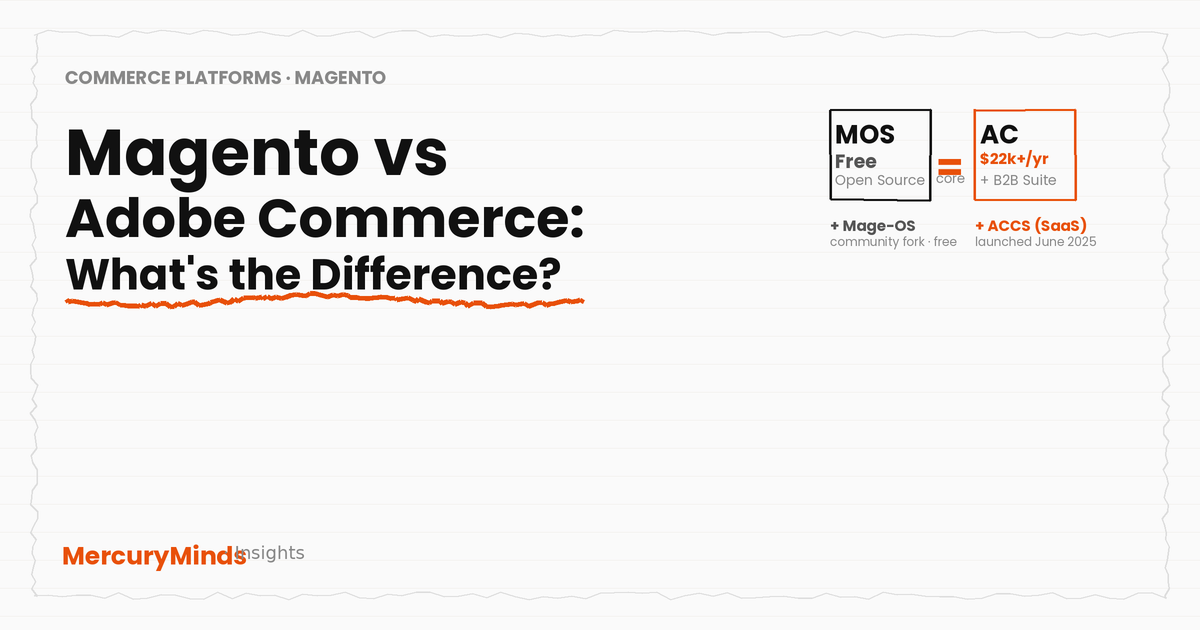
Magento vs Adobe Commerce: What’s Actually the Difference? (2026)
The short answer: Magento Open Source and Adobe Commerce run on exactly the same PHP codebase. The difference is a commercial feature layer sitting on top — primarily Adobe's B2B suite, content staging, customer segmentation tools, and AI-powered recommendations — plus a licence fee that starts at approximately $22,000/year and scales with your gross merchandise volume. In 2026 there is also a third option: Mage-OS, a community-maintained nonprofit fork of Magento Open Source with a faster release cadence and additional features. And a fourth: Adobe Commerce as a Cloud Service (ACCS), a true SaaS model launched in June 2025 that changes the deployment equation for enterprise merchants.
If you've typed this question into a search engine, you're probably dealing with one of two specific confusions. Either someone mentioned "Adobe Commerce" in a conversation and you're not sure if that's the same thing as Magento, or you're already on Magento Open Source and wondering whether you're missing something that Adobe Commerce would give you. Both confusions are reasonable — the naming history alone is enough to disorient a senior developer, let alone a merchant evaluating platforms.
This article gives you the honest, technically grounded answer. It's written for Magento merchants and technical decision-makers who want to understand the actual differences, not marketing positioning. We'll cover what's shared, what's genuinely different, how pricing works in practice (with the caveats it deserves), where Mage-OS fits, and what ACCS means for the landscape going forward.
We work with Magento Open Source and Adobe Commerce merchants across ecommerce and marketplace projects. Our view is that the right answer depends on your specific business model and requirements — not on a category recommendation. We'll present both sides honestly.
The Naming History: Why This Is So Confusing
The confusion is partly Adobe's doing and partly the result of a platform that has been through several identity changes. Here's the timeline:
- 2007–08Magento launched as an open-source ecommerce platform. One codebase, one product.
- 2009Magento Enterprise Edition introduced — a paid version with additional features, primarily for larger merchants. Free version called Magento Community Edition.
- 2015Community Edition renamed Magento Open Source. Enterprise Edition renamed Magento Commerce. Magento 2 released as a major architectural rebuild.
- 2018Adobe acquires Magento for $1.68 billion. The product enters the Adobe Experience Cloud ecosystem.
- 2021Adobe rebrands Magento Commerce to Adobe Commerce. The free edition keeps the Magento Open Source name — the only remaining use of "Magento" in official Adobe product naming.
- 2021Mage-OS founded as a community initiative, growing into a nonprofit fork of Magento Open Source with its own release cadence.
- 2025–26Adobe launches Adobe Commerce as a Cloud Service (ACCS) in June 2025 — a true multi-tenant SaaS model. Mage-OS 3.0 releases in May 2026. The landscape now has four distinct options.
The practical consequence: if you read an article published before 2021 referencing "Magento Commerce," that's what is now called Adobe Commerce. "Magento Enterprise" is even older naming for the same paid product. And when anyone says "Magento" without a qualifier in 2026, they usually mean Magento Open Source — though they may also mean the platform generically, including the paid edition. Context matters.
What's Shared: The Foundation That Makes This Hard to Distinguish
This is the single most important thing to understand about this comparison: both editions share the same PHP core. Not similar cores. The same code.
- The same admin panel layout and functionality for common tasks.
- The same catalogue engine, product types, and attribute management.
- The same checkout flow and guest/account purchase paths.
- The same extension marketplace (Adobe Commerce Marketplace) — extensions built for one edition generally work on the other.
- The same developer tooling: Composer for package management, the same CLI commands, the same module architecture.
- The same upgrade schedule — Adobe ships security patches on the second Tuesday of each month (from 2026), and both editions receive those patches.
- The same third-party ecosystem: Hyvä (the dominant modern frontend theme), Elasticsearch/OpenSearch for search, Redis for caching, and the same hosting stack (PHP 8.3/8.4, MySQL 8.4 or MariaDB 11.4, as of Magento 2.4.8).
One development that has reshaped the Magento ecosystem since 2021 is Hyvä — a commercial frontend theme that replaces Magento's original Luma/Blank frontend stack with a dramatically simpler, faster architecture. Hyvä is now the dominant modern frontend for Magento stores in 2026, and it runs on both editions. If you're evaluating Magento Open Source vs Adobe Commerce, Hyvä does not change the decision — it's a frontend choice, not an edition choice. The one nuance: on Adobe Commerce, Hyvä's core theme works on the frontend, but the B2B module's specific storefront components (company account pages, negotiable quote flows, requisition list interfaces) require explicit Hyvä compatibility verification, since those components were built for Luma. Confirm with your implementation team before assuming full Hyvä compatibility on a B2B Adobe Commerce build.
A developer with three years of experience on Magento Open Source can work on Adobe Commerce immediately. An extension certified for Adobe Commerce will almost always install on Open Source (the reverse is also true, though Adobe Commerce-specific modules that depend on its proprietary features will have reduced functionality on Open Source). If you hire a Magento development agency, they work on both editions interchangeably.
This shared foundation means that choosing the wrong edition isn't catastrophic — migrating from Magento Open Source to Adobe Commerce (or the reverse) is a commercial and configuration change, not a platform rebuild. It's significantly less disruptive than migrating to Shopify or another platform entirely.
What's Actually Different: The Adobe Commerce Feature Layer
Adobe Commerce's enterprise features are real and significant. They're also quite specific — they matter enormously for certain business models and are largely irrelevant for others. Knowing exactly which features are exclusive to Adobe Commerce is the most useful thing to understand before making this decision.
B2B commerce suite (the biggest differentiator)
Adobe Commerce's B2B module is comprehensive and genuinely hard to replicate at comparable quality and cost on Magento Open Source. It includes:
- Company accounts — multiple buyers under a single company account, with configurable roles and permissions. Each buyer can have different catalogue access and purchase limits.
- Shared catalogues — show different products and prices to different customer companies. A wholesale buyer sees different pricing than a retail customer, even within the same store.
- Negotiable quotes — a buyer can request a quote, a sales rep can counter-offer, and the process runs entirely within the storefront without leaving for a separate system.
- Purchase order workflows — purchase approval rules so that orders above a defined value require manager approval before proceeding to checkout. Critical for buyers with procurement controls.
- Requisition lists — saved lists of frequently ordered items for rapid reordering, analogous to a standing order template.
- Credit limits and payment on account — extend credit to approved companies, allowing them to pay on account within defined terms.
Assembling equivalent B2B functionality on Magento Open Source requires multiple third-party extensions — each with its own update cycle, its own vendor support dependency, and its own compatibility testing overhead. For merchants where B2B is a primary channel, the extension assembly route frequently costs more in total than the Adobe Commerce licence, particularly once ongoing maintenance is factored in. For merchants where B2B is incidental or non-existent, this entire feature set is irrelevant.
Page Builder
A drag-and-drop content editor for building CMS pages, category banners, and promotional blocks without developer involvement. Marketing teams can create and schedule campaigns without opening a support ticket. Page Builder has been available in both editions since Magento 2.4.3 — this was previously an Adobe Commerce exclusive but is now shared. Note: the third-party ecosystem has produced strong alternatives (Hyvä's custom page builder integrations, various Magento content builder modules) that many Open Source merchants use effectively.
Customer segmentation and personalised content
Adobe Commerce allows you to define customer segments based on attributes like order history, cart contents, location, customer group membership, and lifetime value — then serve different content, pricing rules, and promotions to each segment dynamically. A returning customer who has spent over £500 sees different homepage banners and offers than a first-time visitor. This is a genuine capability gap; Magento Open Source has no native equivalent, and replicating it with extensions requires careful assembly.
Content staging and preview
The ability to schedule future changes to content, prices, promotions, and category pages — and preview exactly how the site will look at a future point in time before any change goes live. Operationally significant for retailers running coordinated promotional campaigns or seasonal site changes. Not available natively in Magento Open Source.
Advanced reporting and business intelligence
Adobe Commerce includes a more comprehensive reporting suite and, for Cloud customers, integration with Adobe's BI tools. Open Source has basic reporting but relies more heavily on third-party analytics integrations (Google Analytics, Power BI, custom data warehouse connections) for business intelligence. For merchants already running a data warehouse or using an external analytics tool, the Adobe Commerce reporting advantage may be less meaningful.
Adobe Sensei AI — product recommendations and live search
Adobe's AI layer, Sensei, powers two commercially available services for Adobe Commerce: product recommendations (AI-driven "customers also viewed" and "recommended for you" blocks based on behavioural data) and Live Search (an AI-powered on-site search that understands semantic queries). Both require an Adobe Commerce licence and are available as additional services. For Magento Open Source, the equivalent options are third-party AI recommendation engines (Nosto, Klevu, Searchspring) which can match or exceed Sensei's capability depending on implementation.
Adobe support contract
Magento Open Source has no official Adobe support. You're reliant on community forums, your development agency, and the extensive third-party ecosystem. Adobe Commerce includes tiered support contracts — the level of SLA, dedicated support contact access, and incident response time depends on the contract tier. For merchants without strong in-house technical capacity or an established agency relationship, the support contract has real operational value.
Feature Comparison at a Glance
| Feature | Magento Open Source | Adobe Commerce (On-Premise / Cloud) | Notes |
|---|---|---|---|
| Licence fee | £0 | ~$22,000–$125,000+/yr (GMV-tiered) | Adobe does not publish pricing; these are partner-consensus estimates |
| Core codebase | Identical to Adobe Commerce | Identical to Magento Open Source | Same PHP engine, same extension marketplace |
| B2B suite (company accounts, shared catalogues, quotes, POs) | Not included; requires third-party extensions | Included natively | Biggest differentiator for B2B merchants |
| Page Builder | Included (since 2.4.3) | Included | Previously exclusive to Commerce; now in both |
| Customer segmentation | Not included natively | Included | Extensions available for Open Source; native on Commerce |
| Content staging & preview | Not included | Included | Operationally significant for promotional campaigns |
| Adobe Sensei (AI recommendations, Live Search) | Not available | Available as additional paid services | Third-party alternatives (Nosto, Klevu) available for Open Source |
| Advanced reporting / BI | Basic; relies on third-party tools | Enhanced native reporting | Difference narrows if using external analytics |
| Adobe support contract | Community support only | Included (SLA depends on tier) | Value depends on in-house technical capacity |
| Security patches | Same schedule as Commerce | Same schedule as Open Source | Commerce adds extended support for old versions |
| Hyvä frontend compatibility | Full compatibility | Core compatible; B2B storefront components need verification | Hyvä is the dominant modern Magento frontend in 2026 |
| Managed cloud hosting option | Self-managed (any host) | Adobe Commerce on Cloud (PaaS) or ACCS (SaaS) | Open Source can use managed Magento hosts (Nexcess, Hypernode, Cloudways) |
| PHP customisation depth | Full access | Full on PaaS; restricted to App Builder on ACCS | ACCS trades customisation for zero-ops; PaaS retains full code access |
How Adobe Commerce Pricing Actually Works
Adobe does not publish its pricing. Every Adobe Commerce contract is negotiated directly with Adobe or through an Adobe Solutions Partner. What you'll read online — including in this article — is based on consistent ranges disclosed by implementation partners and industry analysts who work with these contracts regularly. Treat these as informed directional benchmarks, not binding figures.
Pricing sourcing note: The figures below are drawn from multiple 2026 sources: mgt-commerce.com (a managed Magento hosting provider with deep pricing visibility), Bemeir (Adobe partner, citing the same mgt-commerce.com analysis), Swell, and Magedelight. These sources converge on similar bands, which gives them reasonable credibility as approximations. They are not official Adobe figures. Adobe's actual contract will depend on your GMV, transaction volume, multi-site requirements, and negotiation leverage. Always request a formal quote from Adobe or an Adobe Solutions Partner before budgeting.
Adobe Commerce On-Premise (self-hosted)
Licence-only, you manage your own hosting infrastructure:
- Under $1M annual GMV: approximately $22,000/year
- $1M–$5M GMV: approximately $30,000–$55,000/year
- $5M–$25M GMV: approximately $55,000–$120,000/year
- $25M+ GMV: typically $120,000–$190,000+/year, increasingly negotiated at this tier
These are licence costs only. Add hosting, DevOps, and ongoing development to get total cost of ownership. Minor version upgrades typically cost $5,000–$20,000 in developer time (SwiftOtter benchmarks cited by Swell). A heavily customised store needs more.
Adobe Commerce on Cloud (PaaS)
Managed AWS/Azure infrastructure bundled with the licence. Multiple sources cite the Cloud premium at approximately 1.8–2.2 times the on-premise licence fee. Approximate ranges:
- Under $1M GMV: approximately $40,000/year
- $1M–$5M GMV: approximately $55,000–$80,000/year
- $5M–$25M GMV: approximately $80,000–$190,000/year
- $25M+ GMV: negotiated, often $190,000+/year
The Cloud premium covers managed hosting (Fastly CDN, auto-scaling, security patching, New Relic monitoring), which removes the DevOps burden from your team. For merchants without strong in-house infrastructure capacity, the operational value of the bundle can justify the premium.
The revenue-participation model: what grows as you grow
The most important pricing characteristic to internalise before signing: the Adobe Commerce licence is tied to your GMV. As your store grows, your licence cost steps up at contract renewal. A merchant who starts at $1M GMV and scales to $10M over three years will find their licence cost increasing automatically at each renewal, based on the higher revenue tier. Model that trajectory into your three-year TCO before committing — the year-one cost comparison against Magento Open Source may look very different from the year-three one.
Magento Open Source has no equivalent cost. Your hosting costs may increase as traffic grows, but there is no platform fee tied to revenue.
The Third Option: Mage-OS
Mage-OS is the development that fundamentally changes the Magento Open Source calculus in 2026 — and it's the one most content about this topic ignores or underweights.
Mage-OS is an independent, nonprofit distribution of Magento Open Source, maintained by the Mage-OS Association. It is explicitly not affiliated with Adobe. It emerged from a community concern — formalised in a public open letter in September 2021 — that Adobe's investment in Magento Open Source was slowing and that the community needed a path to continue evolving the platform independently.
What Mage-OS actually is in practice:
- Fully code-compatible with Magento Open Source 2.4 — existing extensions, themes (including Hyvä), and integrations generally work without modification. Migration from Magento Open Source to Mage-OS is typically a Composer package swap, not a rebuild.
- Faster security patch turnaround — Adobe now publishes security patches on the second Tuesday of each month (from 2026). Mage-OS publishes corresponding updates within days. The same cadence, but verified and community-tested faster.
- Current PHP support — Mage-OS maintains PHP 8.4 compatibility and moves quickly to support new PHP versions. This matters for security and hosting compatibility.
- Community-developed additions beyond the Adobe core — Mage-OS 2.0 (October 2025) added automatic translation (via DeepL, OpenAI, or Google Gemini), a modern admin theme, improved SEO controls (per-page NOINDEX/NOFOLLOW settings, fine-grained robots meta), back/forward cache support, and speculative preloading. These are features Adobe has not shipped in official Magento Open Source releases.
- Mage-OS 3.0 released May 2026 (confirmed from the Mage-OS GitHub release, tag 3.0.0, dated 20 May 2026), including security fixes and PHP 8.4 deprecation corrections.
The critical Mage-OS operational caveat: Mage-OS is volunteer-run and supports only the latest release branch at any given time. If you fall behind on updates, you lose security coverage — there is no extended support model for older branches. For a commercially operated store, this means you must maintain discipline about staying current. The tooling (Composer-based updates, clear upgrade documentation) makes this manageable, but it requires active attention. This is different from Adobe Commerce, where extended support for older minor versions can be purchased.
Adobe Commerce as a Cloud Service (ACCS): What Changes in 2026
ACCS is Adobe's most significant architectural shift since the acquisition. It launched in June 2025 (Americas), August 2025 (EMEA), and Q4 2025 (JPAC) — and it represents a fundamental change in how Adobe Commerce gets deployed.
The traditional Adobe Commerce on Cloud (PaaS) model is single-tenant: your store runs on dedicated AWS/Azure infrastructure provisioned and managed by Adobe, but you still have full code-level access and manage application-level concerns (PHP customisations, module deployments, data migrations). You apply patches when Adobe releases them, with testing responsibilities sitting with your team.
ACCS is genuinely different:
- Multi-tenant SaaS — Adobe manages all infrastructure, updates, and security patches. You never manage a server or apply a patch manually.
- Versionless — monthly releases ship automatically. There is no "upgrade cycle" in the traditional sense; the platform evolves continuously.
- Edge Delivery Services storefront — the frontend runs on Adobe's CDN-edge infrastructure, delivering consistently fast page loads. The Luma theme (Magento's legacy default frontend) is not supported; ACCS is headless-first.
- App Builder for customisation — instead of modifying PHP code directly, merchants and developers build customisations through Adobe's serverless App Builder framework. This is a significant change for teams accustomed to deep PHP-level customisation. Deep core modifications are not possible in ACCS.
- Up to 250 million SKUs — Adobe's catalogue service scales to a level that most Magento implementations would never approach.
ACCS pricing is quote-based and not publicly disclosed. The expectation from industry analysts is that multi-tenant architecture should reduce per-tenant infrastructure costs compared to the PaaS model, potentially making ACCS cheaper for merchants who don't require deep customisation. However, merchants with heavy PHP customisations — custom checkout flows, bespoke integrations, module-level modifications — will face significant migration cost to move those customisations into App Builder before ACCS becomes viable. For those merchants, the PaaS model (or Magento Open Source) may remain the right choice for years.
Existing Adobe Commerce customers: Adobe has confirmed that Commerce on Cloud (PaaS) remains fully supported and there is no mandatory migration to ACCS. Adobe recommends a phased approach: begin integrating available SaaS APIs, adopt Edge Delivery Services for frontend work, and gradually migrate backend PHP customisations to App Builder. This is a multi-year transition, not an immediate requirement.
How to Choose: A Decision Framework
The most common mistake in this decision is using revenue as the primary filter. Large, high-traffic B2C operations run successfully on Magento Open Source (and Mage-OS). Small B2B operations may genuinely need Adobe Commerce's B2B suite from day one. Revenue tells you what you can afford, not what you need.
Use this sequence instead:
Step 1: Is B2B a primary sales channel?
If yes — company accounts, negotiable quotes, purchase approval workflows — Adobe Commerce is likely the more economical choice when you account for the full cost of assembling B2B functionality from Open Source extensions. If no, the B2B suite is irrelevant and should not factor into the decision.
Step 2: Do you need content staging and customer segmentation natively?
If your marketing team runs coordinated campaigns with future-dated content, price, and promotion changes, and customer segmentation is central to how you personalise the experience — Adobe Commerce's staging and segmentation tools have real operational value. If your content operations are simpler, or you're using a headless CMS or external personalisation tool, the Open Source gap here is manageable.
Step 3: Model the three-year TCO honestly
For Open Source: hosting + DevOps + development + extensions + security maintenance. For Adobe Commerce: licence (at your current GMV and projected growth GMV) + hosting (if on-premise) or Cloud/ACCS premium + development + extensions. The Open Source TCO comparison often looks much better at year one than at year three, because the licence cost grows with your revenue while your development costs flatten. Run both scenarios to year three before deciding.
Step 4: Consider Mage-OS if Open Source is the right answer
If your analysis points to Magento Open Source, evaluate Mage-OS as well. It's compatible, adds meaningful features Adobe hasn't shipped, and has a faster security patch cadence. The main consideration is the "latest release branch only" support model — it requires staying current. For a team with active development capacity and discipline around updates, Mage-OS is a compelling choice.
| Profile | Recommended path | Why |
|---|---|---|
| B2C store, no B2B requirements, under $5M GMV, strong dev team | Magento Open Source or Mage-OS | Licence cost exceeds feature value; extensions fill any gaps at lower TCO |
| B2B primary channel — company accounts, quotes, purchase approvals | Adobe Commerce (On-Premise or Cloud) | Native B2B suite; extension assembly cost typically exceeds licence |
| Large B2C, high GMV ($10M+), content-heavy campaigns, segmentation needed | Adobe Commerce (Cloud or evaluate ACCS) | Staging, segmentation, Sensei AI, and support contract justify licence cost |
| Enterprise seeking zero-ops infrastructure, accepts reduced PHP customisation | Adobe Commerce as a Cloud Service (ACCS) | Fully managed SaaS, versionless, Edge Delivery performance — at the cost of deep code access |
| Community-minded merchant wanting Open Source with faster innovation | Mage-OS | PHP 8.4 support, modern admin theme, translation tools, transparent governance — must stay current |
Common Misconceptions Worth Correcting
"Adobe Commerce is only for large enterprises"
Not accurate. A B2B merchant doing $500k in annual GMV with genuine needs for company accounts and negotiable quotes may find Adobe Commerce's B2B suite more economical than assembling the equivalent from extensions and custom development. Revenue is a poor filter; business model requirements are the right filter.
"Magento Open Source can't scale"
Incorrect. Scalability on Magento is a function of infrastructure and implementation quality, not edition. Large, high-volume DTC operations run on Magento Open Source successfully. The architecture handles scale; what doesn't scale automatically is poorly configured hosting or inefficient custom code — problems that affect Adobe Commerce implementations equally.
"Mage-OS is a risky bet"
Worth examining rather than dismissing. Mage-OS has a formal nonprofit governance structure, an elected board, transparent financials (published annually), over 172 financial contributors, and a growing community of professional members and agencies. It shipped three major releases in 2025 and Mage-OS 3.0 in May 2026. The risk profile is different from a corporate-backed product, but it's not comparable to an abandoned open-source project.
"Adobe Commerce pricing is fixed and published"
Incorrect. Every Adobe Commerce contract is negotiated. Multi-year terms, bundle purchases with other Adobe Experience Cloud products, and implementation partner relationships all move the number. The figures cited in this article are partner-consensus estimates that converge across multiple independent sources — useful for ballpark planning, not for budgeting without a formal quote.
Limitations of This Article
- Adobe Commerce pricing is not publicly disclosed. All figures in this article are drawn from partner and industry analyst sources (mgt-commerce.com, Bemeir, Swell, Magedelight — all 2026). They represent the best available proxy data, not official Adobe figures. Always request a direct quote.
- ACCS feature availability evolves rapidly. B2B features (shared catalogues, quote management) were described as "coming soon" in some early 2025 sources; verify current ACCS feature parity against Adobe's documentation before evaluating for B2B use cases.
- Magento version currency: the current stable release is Magento 2.4.8 as of this writing (Magento 2.4.9 reached GA in May 2026 per Bemeir). Verify at devdocs.magento.com before making version-specific infrastructure decisions.
- Mage-OS 3.0 confirmed from the GitHub releases page (May 20, 2026). Check mage-os.org for the latest release and any governance or support model changes before committing a commercial store to the platform.
Running Magento Open Source or Adobe Commerce and not sure if you're on the right version?
MercuryMinds has built, upgraded, and integrated Magento and Adobe Commerce stores for 17+ years. We give you a straight answer on whether your current setup serves your business — and a plan if it doesn't.
Talk to the TeamFrequently Asked Questions
What is the difference between Magento and Adobe Commerce?
Magento Open Source and Adobe Commerce run on exactly the same PHP codebase — the same catalogue engine, the same checkout flow, the same extension marketplace. The difference is a commercial feature layer that Adobe has added on top: full B2B account management (company accounts, negotiable quotes, shared catalogues, purchase approval rules), Page Builder for drag-and-drop content editing, advanced customer segmentation, content staging and preview, and AI-powered product recommendations through Adobe Sensei. Adobe Commerce is licensed annually on a GMV-tiered model starting at approximately $22,000/year (not publicly disclosed — all contracts are negotiated). Magento Open Source carries no licence fee.
Is Magento the same as Adobe Commerce?
They share the same codebase but are different products. Adobe acquired Magento in 2018 and rebranded the enterprise edition as Adobe Commerce in 2021. The free edition kept the Magento Open Source name. A developer experienced on one can work on the other without retraining. What separates them is not architecture but a defined layer of enterprise features that Adobe has built for the paid edition, plus an annual licence fee that scales with your gross merchandise volume.
What is Mage-OS and how does it relate to Magento?
Mage-OS is an independent, nonprofit distribution of Magento Open Source, maintained by the Mage-OS Association — a community of developers, agencies, and merchants. It is not affiliated with Adobe. Mage-OS ships faster bug fixes, maintains current PHP compatibility (including PHP 8.4), and adds community-developed features (automatic translation, improved SEO controls, a modern admin theme) that Adobe has not included in the official Magento Open Source releases. As of May 2026, Mage-OS 3.0 is the current release. Existing Magento extensions and themes generally remain compatible, as Mage-OS stays aligned with the Magento 2 core.
What is Adobe Commerce as a Cloud Service (ACCS)?
Adobe Commerce as a Cloud Service (ACCS) is a fully managed, multi-tenant SaaS version of Adobe Commerce, launched in June 2025 (Americas), August 2025 (EMEA), and Q4 2025 (JPAC). Unlike the traditional Adobe Commerce on Cloud (PaaS), which is single-tenant and requires merchants to manage application-level concerns, ACCS handles all infrastructure, security patches, and upgrades automatically. Storefronts run on Edge Delivery Services; customisation is handled through Adobe's App Builder rather than PHP code modifications. Pricing is quote-based and not publicly disclosed. ACCS suits merchants who want zero infrastructure management and can accept the reduced PHP customisation flexibility.
Should I upgrade from Magento Open Source to Adobe Commerce?
The primary reasons to move from Magento Open Source to Adobe Commerce are: you need Adobe's native B2B suite (company accounts, negotiable quotes, shared catalogues) and building equivalent functionality from extensions has proven costly; or you need Adobe's content staging, customer segmentation, and Sensei AI recommendations and cannot replicate them affordably with third-party tools. The primary reasons to stay on Open Source are: your store is B2C-only with no B2B requirements; you prefer managing your own hosting and extensions; your GMV is under $5M and the licence cost significantly exceeds the TCO of Open Source plus a curated extension stack. Revenue alone is a poor filter — large, high-traffic B2C operations run successfully on Open Source.