
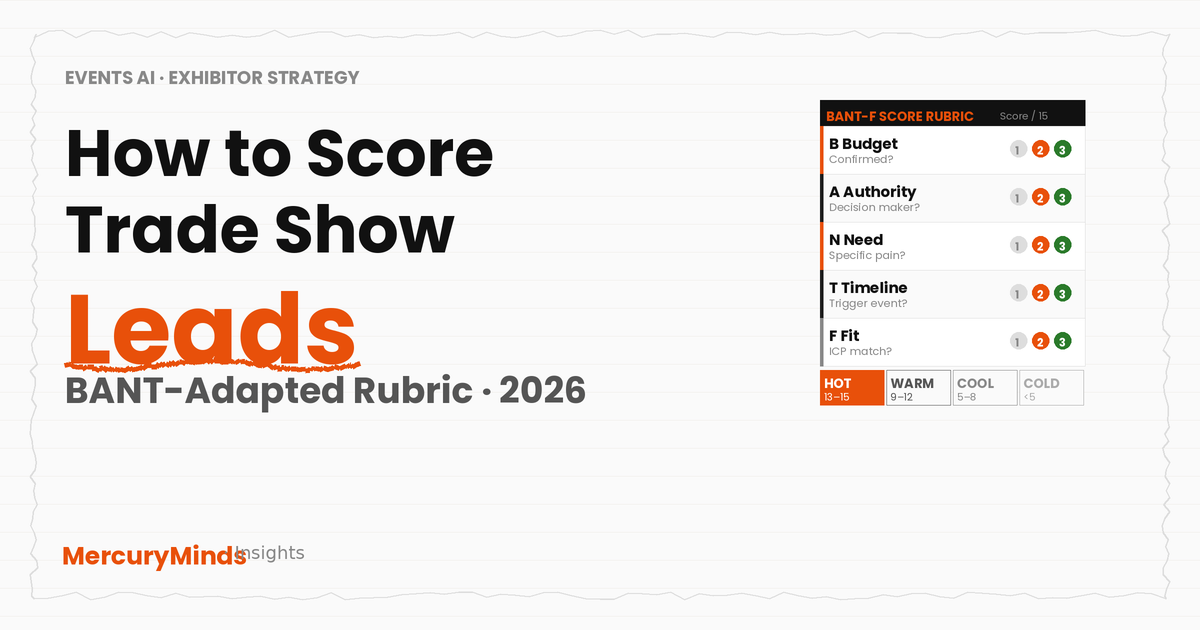
How to Score Trade Show Leads: A Practical Framework (2026)
The short answer: Score trade show leads immediately using a BANT-adapted rubric (Budget, Authority, Need, Timeline) on a 12-point scale. Leads scoring 10–12 are hot — follow up the same day or next business day. Leads scoring 7–9 are warm — follow up within 48–72 hours. Leads scoring 4–6 are cool — monthly nurture. Below 4 — newsletter only. The rubric table is in this article. The framework works because it forces your team to have a qualifying conversation rather than just scanning a badge — and 80% of trade show leads are never followed up on because they were never properly qualified in the first place.
Your booth costs $40,000 when you total the floor space, build-out, travel, hotels, and staff time. You collected 180 badge scans over three days. Six weeks later, your CRM shows 18 follow-up emails sent, 3 meetings booked, 0 pipeline opportunities created. That is a $13,000-per-meeting rate — and the CFO is asking whether to cut the trade show budget.
The problem is almost never the show itself. It is the gap between contact and conversion — the 62 leads that went nowhere because nobody could remember the context of the conversation, the 40 badge scans who just wanted a free water bottle, and the 15 genuine prospects who received the same generic "great meeting you at [EVENT NAME]" email that everyone else received. Lead scoring solves this. Not perfectly — no system does — but systematically. And systematic beats individual effort at scale.
This guide gives you a complete, deployable lead scoring system for trade shows: the scoring rubric itself, the qualifying questions to ask during booth conversations, the routing SLAs for each tier, and the follow-up structure that converts. It is designed for the exhibitor who is standing at a booth and needs something their team can actually use under show-floor conditions — not a theoretical framework that requires a sales ops PhD to implement.
Why Most Trade Show Lead Programmes Fail
Before the framework, the diagnosis — because understanding why leads fail is what makes the solution stick.
Problem 1: Badge scanning is not lead qualification
The badge scanner is the single most abused piece of event technology. It captures a contact record efficiently. It captures absolutely nothing about the conversation that preceded or followed the scan. Two minutes after scanning, your booth representative has moved on to the next visitor. By the time the show ends on day three, the context of 95% of those conversations is gone. Your CRM has 180 records. You have no idea which 15 of them were worth calling.
Scanning and qualifying are different activities. Scanning requires half a second. Qualifying requires a conversation — asking the right questions, listening for the right signals, and recording the context that makes follow-up possible. The exhibitors who generate pipeline from trade shows treat every badge scan as the beginning of a conversation, not the end of one.
Problem 2: Uniform follow-up treats all leads as equal
Even exhibitors who do follow up typically send the same email sequence to every contact — a generic "great meeting you" with a product brochure attached. This approach has two problems. First, it is irrelevant to most recipients: the person who spent 45 minutes discussing a specific problem receives the same email as the person who grabbed a pen from your bowl. Second, it trains prospects to ignore your emails — and once they have marked one as irrelevant, the next one faces the same fate.
Scoring enables segmentation. A hot lead receives a personalised email referencing the specific pain they articulated in your conversation. A warm lead receives a value-led sequence. A cold contact goes into a long-cycle newsletter. Different content, different timing, different sales investment — all from the same 180 badge scans.
Problem 3: Context fades faster than you think
At a busy trade show, a booth representative has 30–50 conversations per day. By the end of day two, the conversations from day one's morning session are a blur. The scoring and note-taking discipline you build into your process is the only mechanism that preserves the context that makes personalised follow-up possible. Every hour that passes between a conversation and capturing notes reduces the quality of the data you will use to follow up. This is why scoring at or immediately after capture — before the next conversation begins — is the right discipline, even if it feels disruptive to the booth rhythm.
The Trade Show Lead Scoring Rubric
The rubric below adapts the standard BANT (Budget, Authority, Need, Timeline) sales qualification framework for the specific context of a trade show booth conversation. BANT was designed for a structured sales discovery call — typically 30–60 minutes with a pre-qualified prospect. A booth conversation is different: it is often 5–15 minutes, the prospect is in a browsing mindset rather than an evaluation mindset, and interruptions from the show floor are constant.
The adaptation makes three changes. First, the questions are reframed to feel natural in a casual conversation rather than like an interrogation. Second, the scoring is simplified to three levels per dimension (not five) to reduce cognitive load on the booth representative. Third, the framework explicitly includes a fifth dimension — Fit — that is absent from standard BANT but critical for booth qualification: does this person's company profile match your ideal customer profile at all?
| Dimension | Score 1 — Low signal | Score 2 — Medium signal | Score 3 — Strong signal |
|---|---|---|---|
| B — BudgetCan they fund a decision? | No budget mentioned; early awareness stage; no current spend on this problem | Budget exists in principle but not yet allocated or approved for this category | Budget is confirmed, approved, or actively being created for this problem in the current cycle |
| A — AuthorityCan they influence or decide? | End user or researcher with no purchasing influence; does not know who decides | Has input into the decision or is part of the evaluation team; not the economic buyer | Economic buyer, decision-maker, or named champion who will advocate internally |
| N — NeedDo they have a specific problem? | General curiosity; browsing the show; no specific pain articulated | Pain or challenge identified but solution is not an active priority right now | Specific, named operational pain articulated; actively looking for a solution; knows the cost of the problem |
| T — TimelineWhen will they decide? | No timeline; "someday" or "maybe next year"; no trigger event identified | Evaluating within 3–12 months; has a general sense of when they might act | Actively evaluating now or deciding within 0–3 months; specific trigger event (contract renewal, new FY, product launch) driving urgency |
| F — FitDoes their profile match your ICP? | Company size, industry, or use case is clearly outside your ideal customer profile | Partial ICP match: some characteristics fit, others do not; edge case worth investigating | Strong ICP match: company size, industry, use case, and technical environment all align |
Score override rule: A lead with a score of 1 on Need is cold regardless of total score. A person with confirmed budget, decision-making authority, a matching ICP, and a 3-month timeline but no articulated problem will not convert — they are exploring or doing competitive research. Never advance a lead without at least a 2 on Need. Similarly, a lead who scores 3 on all dimensions but whose company is completely outside your ICP (score 1 on Fit) is a detour, not an opportunity.
This rubric is intentionally simple. In a booth conversation, a representative cannot reliably score 10 dimensions while maintaining eye contact and building rapport. Five dimensions, three levels each, is the upper limit of what can be executed consistently under show-floor conditions. The simplicity is the feature, not a limitation.
The Qualifying Questions That Make the Rubric Work
The rubric without questions is a blank scorecard. These questions are adapted for natural booth conversation — not a checklist interrogation, but a conversational arc that surfaces the data you need to score each dimension. The order matters: start with their world (Need and Fit), move to their process (Authority), and let Budget and Timeline emerge naturally as the conversation develops.
Fit — open the conversation, not the checklist
Begin here: you establish relevance before any qualification. If they are not a fit, you know immediately and can close the conversation respectfully.
- "What brings you to the show today — are you exploring a specific area or looking at a few things?"
- "What does your team primarily do? Are you on the [industry vertical] side or more [adjacent function]?"
- "How big is your team — just so I can give you the most relevant picture of what we do?"
- "Are you the one who typically looks at this type of solution, or is there a colleague who owns this area?"
These questions reveal ICP fit naturally. A 5-person startup asking about your enterprise solution is score 1 on Fit — acknowledge the interest graciously and move on. A 200-person distributor in your target vertical is score 3 — invest the conversation.
Need — surface the pain before pitching the product
Listen before you pitch. The most common booth mistake is launching into a product demonstration before understanding whether the visitor has a problem you actually solve.
- "What's the specific challenge you're trying to solve right now — or are you more in the information-gathering phase?"
- "How are you currently handling [the problem your product solves]? What's frustrating about that?"
- "What does that challenge cost you in time, money, or team capacity?"
- "What would solving this enable you to do that you cannot do right now?"
A visitor who can answer "what does that challenge cost you?" specifically — in dollar or hour terms — is a score 3 on Need. A visitor who says "we've been meaning to look at this space" is a score 1. The cost-of-inaction question is the most revealing: people with real problems know their cost of inaction.
Authority — find the champion and the committee
In modern B2B buying, the "decision-maker" is almost always a committee. The goal is not just to find who can sign — it is to understand the buying committee structure so your follow-up can reach the right people.
- "When a decision like this moves forward, who typically gets involved beyond yourself?"
- "Is there someone on your team who owns the budget for this area, or does it come from a different part of the business?"
- "Have you brought any other colleagues to the show, or is this more of a solo exploration for now?"
- "If you found something that worked, what would the process look like internally to move it forward?"
You are looking for: does this person have organisational influence? Can they describe the decision process? If they say "I'd probably just bring it to my manager," that is a score 2 on Authority — they are a contributor, not a champion. If they say "I own this budget and I'd be the one making the recommendation to our VP," that is a score 3.
Budget — frame around value, not price
Never ask "what is your budget?" at a trade show — it feels transactional and shuts down conversation. Instead, understand how decisions like this get funded at their organisation, and what the cost of inaction looks like.
- "How does your company typically approach decisions in this space — is it a planned budget line, or more of an opportunistic investment?"
- "Are you at the stage of evaluating ROI, or are you more in the early awareness phase?"
- "Do you have a ballpark sense of what you'd want to invest in solving this — even a range helps me point you in the right direction."
- "Is this something you'd expect to fund this year, or is it more of a planning-for-next-year conversation?"
Budget signals are often indirect at shows. "We have a project planned for this year" is a budget signal. "We've been talking about this for a while" is not. A score 3 is someone who can name a budget range or describe an approved project. A score 1 is someone who is curious but has no funding context whatsoever.
Timeline — find the trigger event, not the aspiration
Timelines stated without a trigger event are aspirations. A trigger event is a specific business circumstance — a contract expiring, a fiscal year starting, a product launch — that creates urgency beyond general interest.
- "Do you have any specific milestones or deadlines driving this — a contract coming up, a product launch, a new financial year?"
- "Are you looking to make a decision this year, or more exploring what's available in the market?"
- "What would need to happen for this to become a priority in the next 90 days?"
- "If you found the right solution here at the show, is this something you'd want to move forward quickly, or would it need to go through a longer evaluation process?"
A trigger event makes timeline real. "Our current contract expires in March" is a score 3. "We're hoping to do something by year-end" is a score 2. "Eventually we'll need to address this" is a score 1.
Scoring at Capture vs Post-Event: The Right Approach
This is the most debated question in trade show lead management, and the answer is: both, in sequence.
Scoring at capture (during or immediately after the conversation)
The case for scoring at the point of capture is strong. Context is freshest. The conversation is still in short-term memory. The exhibit visitor has not yet left your mental frame and been replaced by the next fifteen. A quick tier assignment — H, W, C — takes three seconds and routes the lead immediately. Companies that score leads at the point of capture see 38% higher conversion rates in post-show follow-up (Trade Show PRO, 2026).
The limitation is accuracy under show conditions. In a busy booth where five conversations are happening simultaneously, asking a representative to score all five BANT dimensions while managing the conversation creates cognitive overload. The compromise: capture-time tagging is a single tag (H, W, C) plus a 15-second voice note or text note capturing the most critical context from the conversation.
AI-enabled capture apps make this significantly easier. Tools like Conexa, BoothIQ, and iCapture allow voice memos that are transcribed and structured automatically — a 15-second voice note after each conversation captures the pain point, the authority level, and the next step without taking the representative off the floor for more than a moment.
Post-event scoring (within 4 hours of the conversation)
The full BANT-adapted rubric — all five dimensions, each scored 1–3 — should be completed within four hours of each conversation, while notes and context are still accessible. For a day-long show, this means a structured debrief session at the end of each show day where the team reviews every conversation, assigns scores, and captures follow-up notes. A 2-minute review per lead on 30 leads = 60 minutes. Run it over dinner the night of each show day. The investment is proportional to the value of the leads it produces.
The combination approach
The recommended workflow: at-capture tagging (H/W/C) for immediate routing; 4-hour full rubric scoring for complete BANT assessment; morning review on show day 2 and 3 to validate the previous day's hot leads and ensure follow-up has been initiated before the next session begins.
Hot / Warm / Cool / Cold Routing SLAs
A score means nothing without a routing commitment. These SLAs define what must happen for each tier, by when, and who owns it. Set them before the show, communicate them to the full booth team, and track compliance post-show.
HOT
Same-day or next business day. Personalised call or email referencing specific conversation content. Next step must be a calendared meeting or demo — not an open-ended "let's talk." Sales rep ownership, not marketing automation.
WARM
Within 48–72 hours. Segmented, personalised sequence leading with relevant content (case study, guide, demo video) before requesting a meeting. Review and refine score at first response. Move to Hot if they engage or request a meeting.
COOL
Within 1 week. Add to a monthly nurture sequence — relevant industry content, webinar invitations, event follow-ups. Review quarterly. Move up if they engage with multiple touches or respond requesting more information.
COLD
Newsletter only. No active sales follow-up. Retain in CRM in case they re-engage. Review annually for any status change. Do not invest sales time in this tier.
The most important SLA is the hot lead response time. Research from MIT and InsideSales.com, cited across multiple 2026 sources, found that leads contacted within five minutes are 21 times more likely to qualify than those contacted after 30 minutes. For trade shows, where follow-up happens hours or days later, this decay has already occurred — the goal is to minimise further delay from close-of-show to first contact. Follow-up emails sent within 24 hours of a trade show achieve a 48% open rate versus 21% for emails sent a week later (Mailchimp and Exhibitor Magazine research). That 27-percentage-point difference in open rate is the direct cost of slow follow-up.
The Follow-Up System That Converts
Hot lead protocol: the personalised first touch
A hot lead follow-up should reference your specific conversation. Not the show name mail-merged into a template — the actual conversation. The problem they articulated, the current situation they described, the next step they indicated interest in. If you have done the note-capturing correctly, you have this information. If you do not, you will write a generic email indistinguishable from the 46 other exhibitor emails in their inbox.
Structure for a hot lead first email: one sentence acknowledging the specific conversation and the pain they mentioned; two sentences on how your solution addresses that specific pain (not your full value proposition — the specific application); one sentence on the next step you are proposing and why it makes sense. No attachments in the first email — attachments signal a broadcast, not a conversation. Total length: four to six sentences.
Subject line formula: [their company's specific challenge] — follow-up from [show name]. For example: "Inventory sync across 3 warehouses — follow-up from NRF" rather than "Following up from National Retail Federation 2026." Specificity is what gets it opened.
Warm lead protocol: value-first sequence
Warm leads are not ready to meet — they are evaluating whether your category is worth their time. The follow-up sequence delivers value before requesting a commitment. A three-touch structure over seven days:
Day 1: Personalised email (lighter personalisation than hot — reference the show and the area of interest, not a specific conversation detail). Include one relevant resource (case study, guide, or benchmark report) that addresses the category challenge you discussed. No meeting request.
Day 3: Short follow-up referencing the resource — "Did the [guide name] land in a useful way?" — and offering one additional perspective or insight. The goal is a reply, not a meeting.
Day 7: Soft meeting request. "Based on our conversation and your focus on [challenge area], a 20-minute call to walk through how [specific client type] has tackled this might be worth your time. Happy to make it fit your schedule." Specific duration, specific value proposition for the call, low-commitment framing.
Pre-show outreach: the overlooked lead multiplier
The most effective exhibitors do not wait for leads to come to the booth — they manufacture warm leads before the show opens. Pre-show outreach to target accounts who are registered for the event, requesting brief meetings during the show, converts the show floor into a venue for a scheduled conversation rather than a cold encounter. Meeting a prospect who is already aware of your solution context and has agreed to 20 minutes of booth time converts at dramatically higher rates than a cold badge scan.
The research corroborates this: 51% of trade show attendees request that a sales representative visit their company after the show, according to CEIR data. The exhibitors who reach those attendees before the show floor opens — via LinkedIn, targeted email, or event app messaging — are the ones getting those post-show meetings.
Technology for Trade Show Lead Scoring
The scoring rubric can be implemented on a piece of paper. In 2026, dedicated lead capture technology makes it significantly more effective and eliminates the most common failure mode — context loss between capture and CRM entry.
iCapture (now owned by Cvent following January 2024 acquisition): enterprise-grade, works across event badge platforms (Cvent, Expo Logic, CompuSystems), custom qualification surveys that capture BANT data, offline mode for convention center dead zones, direct CRM sync. Best for teams attending 3+ major shows per year with Salesforce or HubSpot.
Conexa: AI-powered capture with automated enrichment and instant follow-up sequences triggered at the moment of capture. Conversation notes are structured by AI. Best for teams where personalised follow-up speed is the priority.
BoothIQ: AI/OCR scanner for any badge type, voice memo to structured notes, team-shared lead view. Flat monthly fee. Best for teams who need simplicity and shared visibility without enterprise complexity.
Captello: gamification + serious lead capture; 60+ game templates for drive-by traffic, plus full qualification forms and 6,000+ CRM integrations. Best for consumer-facing or high-traffic exhibitors.
Whatever tool your team uses, the non-negotiable integration is your CRM. Leads that live in a lead capture app but never sync to Salesforce or HubSpot will not be followed up. The data from the show must be in the sales team's primary system — tagged by event, by score, and by next action — before the team lands home from the show.
Common Mistakes That Kill Trade Show Lead Programmes
Measuring quantity instead of quality
The badge scan total is the vanity metric of trade show marketing. A show where your team had 30 meaningful qualifying conversations is more valuable than a show where they scanned 200 badges and did not talk to anyone. If your team's post-show debrief focuses on total scans rather than hot lead count and hot lead quality, you are measuring the wrong thing — and your booth strategy will optimise for scan volume rather than conversation quality.
No pre-defined handoff between marketing and sales
In approximately 42% of organisations, marketing assumes sales will handle follow-up while sales assumes marketing will nurture leads first (SurFox, 2026). The result: no one follows up, or both teams follow up inconsistently. Define handoff ownership before the show. For hot leads: sales owns follow-up, initiated within 24 hours. For warm: marketing owns the first two touches of the automated sequence; sales takes over if the lead responds or engages. For cool and cold: marketing owns nurture indefinitely, sales reviews quarterly.
Capturing contact data but not conversation context
The most common CRM entry after a trade show: Company Name, First Name, Last Name, Email, Phone. Missing: what they said, what they were struggling with, what stage they were at, what the next step was. A CRM record without context is as useless as a business card in a bowl. The note field is not optional — it is the mechanism that makes personalised follow-up possible.
Uniform follow-up timing
Sending the same follow-up email on the same day to all 180 contacts — regardless of score — means hot leads wait while marketing operations processes the full export, and cold contacts receive sales outreach they did not earn. Tier-based follow-up routing, triggered by score, solves this. Hot leads route to sales the moment they are scored. Cool leads route to a monthly newsletter sequence. The infrastructure for this exists in every major marketing automation platform — it requires configuration before the show, not after.
Exhibiting at an event and want to build a lead capture and activation system that actually converts?
MercuryMinds builds event data collection and post-event activation systems for exhibitors and event organisers. We integrate lead scoring, CRM routing, and follow-up automation into a single workflow — so your team walks off the show floor with a live pipeline, not a spreadsheet.
Talk to the TeamQuick Reference: Trade Show Lead Scoring Checklist
Print this and put it in your booth kit. Every item should be resolved before the show opens.
| When | Action | Owner |
|---|---|---|
| 2 weeks before | Define ICP criteria for the show; brief booth team on BANT-adapted rubric; configure scoring fields in lead capture app | Sales/Marketing lead |
| 1 week before | Pre-show outreach to target accounts registered for the event; schedule booth meetings with priority accounts | Sales rep |
| Day before | Run rubric training session with full booth team; confirm CRM integration is live; set up automated sequences in marketing automation | Operations |
| At capture | Tag lead H/W/C; record 15-second voice note with pain point and next step; sync to CRM before next conversation | Booth rep |
| End of each show day | Full rubric review of all that day's leads; assign BANT-F score; confirm hot leads are routed to sales; brief team on next day's priority accounts | Team lead |
| Within 24 hours of show close | Personalised follow-up sent to all hot leads; warm sequence launched for warm leads; cool added to monthly nurture | Sales / Marketing automation |
| 1 week post-show | Review hot lead response rates; convert any warm leads who engaged into hot; debrief on rubric accuracy vs. actual outcomes | Sales manager |
| 30 days post-show | Pipeline report: how many hot leads created opportunities? What was the show's contribution to pipeline? | Revenue/Ops |
Limitations of This Framework
- The BANT-adapted rubric in this article is a starting point, not a definitive system. It should be calibrated to your specific sales cycle — companies with 12-month enterprise sales cycles will weight Authority and Timeline differently than companies with 30-day transactional cycles.
- Statistics cited (80% of leads not followed up, 48% open rate at 24 hours, 6–9× conversion improvement) are from industry analyses and should be treated as directional benchmarks. Primary sources are cited in the sources section and vary in methodology and publication date.
- The MIT/InsideSales.com lead response study (21× conversion at 5 minutes) was originally published in 2011. Its fundamental finding — that speed of response is a primary conversion driver — is consistently corroborated in more recent research, but the specific multipliers may not apply to all sales contexts.
- Technology recommendations (Conexa, BoothIQ, iCapture, Captello) are from 2026 sources. Platform features and pricing change — verify current capabilities before purchasing.
Frequently Asked Questions
How do you score trade show leads?
Score trade show leads using a BANT-adapted framework with five dimensions scored 1 to 3 for a maximum of 15 points. Budget (1 = no confirmed budget, 2 = budget exists but unallocated, 3 = budget confirmed and approved). Authority (1 = influencer with no buying authority, 2 = contributor to the decision, 3 = decision-maker or champion). Need (1 = general curiosity, 2 = pain identified but not a priority, 3 = specific pain articulated and actively seeking a solution). Timeline (1 = no timeline, 2 = evaluating in 3–12 months, 3 = deciding in 0–3 months with a trigger event). Fit (1 = outside your ICP, 2 = partial match, 3 = strong ICP match). Leads scoring 13–15 are hot: same-day or next-business-day follow-up. Leads scoring 9–12 are warm: follow up within 48–72 hours. Leads scoring 5–8 are cool: monthly nurture. Below 5: newsletter only.
How quickly should you follow up with trade show leads?
Follow-up emails sent within 24 hours of a trade show achieve an average open rate of 48%, compared to 21% for emails sent one week after the event — less than half the engagement. Companies that follow up within 24 hours are 6 to 9 times more likely to convert than those who wait a week or more. For hot leads (score 13–15), follow up the same day or next business day with a personalised email referencing your specific conversation. For warm leads (score 9–12), follow up within 48–72 hours with a value-led sequence. The 24-hour window is non-negotiable: 50% of trade show buyers choose the vendor that responds first with relevant information.
What is the BANT framework for trade show lead qualification?
BANT stands for Budget, Authority, Need, and Timeline. Adapted for booth conversations at trade shows, it works as a structured but natural qualification framework. Budget: rather than asking directly what their budget is, ask how decisions like this are typically funded at their company, or what the cost of not solving this problem is over the next year. Authority: determine not just whether this person can sign, but who else is involved in the decision. Need: establish the specific operational pain, not just general interest. Timeline: identify any trigger event (a contract expiring, a product launch, a budget cycle starting) that drives the timeline. Each dimension is scored 1 to 3 at the booth or immediately after the conversation, giving a total score that determines routing and follow-up priority.
Should you score trade show leads at the booth or after the event?
The most effective approach combines both. At-capture tagging (a single H, W, or C designation) during or immediately after each conversation preserves context and enables same-day routing for hot leads. Full BANT scoring should be completed within 4 hours of the conversation using notes captured during the exchange. Companies that score leads at the point of capture see 38% higher conversion rates in post-show follow-up. The recommended workflow: capture-time tagging for immediate routing, then a full rubric review at the end of each show day while context is still fresh.
What percentage of trade show leads convert to sales?
Across exhibitors who follow up effectively, 5 to 10 percent of trade show leads convert to sales. Only 5 to 15 percent of trade show leads are ready to buy immediately at the time of the event. Trade show leads require an average of 3.5 sales calls to close, versus 4.5 calls for a cold lead. Trade show leads also cost less to acquire: average cost per trade show lead is $100 to $300, compared to $400 to $600 for outbound sales leads. The conversion rate improvement from structured lead scoring is substantial — companies with a defined qualification process at the booth convert significantly more leads than the 80 percent of exhibitors who follow up inconsistently or not at all.